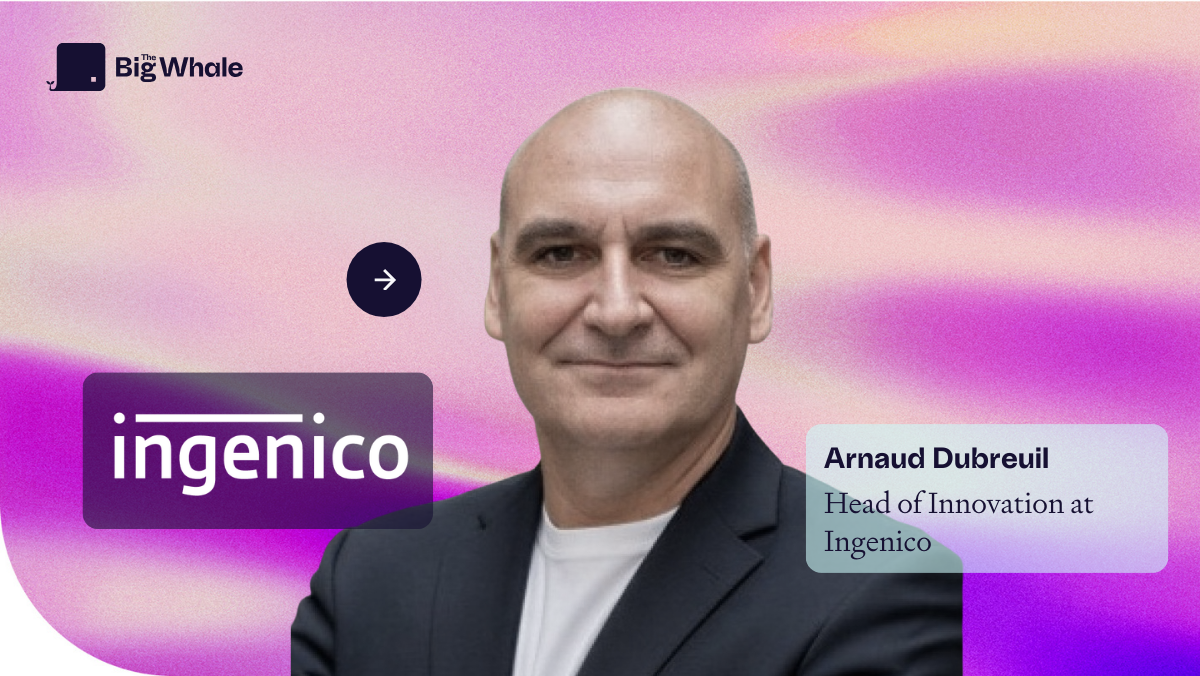
TBW - Arnaud Dubreuil (Ingenico): “Our goal is for a stablecoin transaction to be 10% cheaper than a card”
The Big Whale: What was the starting point for your strategic pivot toward digital assets?
Arnaud Dubreuil: Our mission within Ingenico Labs is to analyze market friction and design solutions that will become industry standards within the next three to five years. We operate as a highly practical laboratory: we develop, we test in the field with merchants, and we measure actual adoption.
We’ve been working on digital assets for four years now. Initially, we focused on in-store acceptance of "traditional" cryptocurrencies through partnerships with players like Binance and Crypto.com. The idea was to allow the customer to pay in crypto and the merchant to receive it in kind.
What were the key takeaways from those initial pilots?
We quickly realized that this was a niche market. Cryptocurrency holders view their assets as either an investment or a store of value. In both cases, they are reluctant to spend them—except perhaps during significant bull markets when people are looking to realize gains.
Most importantly, we identified a major hurdle on the merchant side: accounting complexity. Receiving volatile assets creates revenue recognition and treasury management issues that retailers simply do not want to handle. For broad adoption, it was imperative that the merchant receive fiat (euros or dollars). This realization led us to pivot toward stablecoins, which we are currently testing with a handful of merchants before considering a production rollout in the coming weeks.
Why do stablecoins seem like the right vehicle for in-store payments today?
Their stability provides reassurance across the entire ecosystem, from acquiring banks to retailers. But it’s primarily a question of volume. Stablecoin transactions are now reaching levels comparable to—and in some segments, higher than—those of Visa and Mastercard combined. This is no longer a technological curiosity; it is a medium of exchange that is becoming truly transactional. For our banking clients, the fact that this is no longer a "world first" significantly eases integration and deployment.
“With WalletConnect, the user sticks to the wallet they already own”
You recently announced a partnership with WalletConnect. Why choose this technical path rather than integrated solutions like Binance Pay?
User experience is our absolute priority. We refuse to force users to download yet another application. Ingenico is an "unconscious brand": people use our terminals without necessarily knowing our name. They will never download an Ingenico app just to make a payment.
With WalletConnect, the user utilizes the wallet they already own. We display a QR code on the terminal, they scan it, and they remain within their familiar environment. It’s an agnostic approach. Closed-loop solutions often impose constraints on both the customer and the merchant, creating entry barriers we wanted to avoid.
Which blockchain networks support these transactions? Is Ethereum’s Layer 1 viable for retail?
No, Ethereum’s Layer 1 is currently excluded from our in-store solutions. Processing times and fees are incompatible with the demands of retail commerce. A customer cannot wait ten minutes at a terminal.
Instead, we have migrated to fast, low-cost networks like Polygon or Base. The goal is to mitigate financial risk: if a transaction takes too long to confirm, someone in the ecosystem must bear the risk of the transaction eventually failing. By using infrastructure capable of confirming a transaction in seconds, we eliminate that friction.
How does the transaction work in practice for the merchant?
The integration must be transparent. On our Android terminals, we can push the stablecoin payment application remotely. The merchant simply selects this payment method when needed. Eventually, the goal is to integrate this seamlessly into the primary payment application.
The more complex aspect remains the operational side, specifically settlement. The merchant wants their euros. Therefore, we work with off-ramping partners like Iron, who handle immediate conversion and transfers to the merchant's bank account. This involves a KYC (Know Your Customer) process for the retailer. If we operate through an acquiring bank, we leverage existing information to simplify the administrative steps.
“An algorithm analyzes the transaction and provides an instant score to decide whether we accept it or not”
Cost is often the ultimate argument for merchants. What is the business model for this solution?
We follow a hybrid model: a monthly license fee for activating the service on the terminal, plus a commission per transaction. Our initial goal with these pilots is to be approximately 10% cheaper than traditional credit card interchange fees.
Structurally, stablecoin payments can be more cost-effective, but this also depends on fiat conversion costs. This is precisely what we are testing now—to ensure the model is viable for all stakeholders in the chain.
What about compliance and Anti-Money Laundering (AML) efforts, especially with non-custodial wallets?
This is a critical point. We utilize real-time KYT (Know Your Transaction) mechanisms. An algorithm analyzes the transaction and provides an instant score to decide whether we accept it or not.
When we work with banks, they perform this assessment, as it is their core business. We rely on established technology partners to guarantee that flows are not compromised. Security on our Android terminals is also reinforced with specific software layers and PCI certifications—far beyond the vulnerability of a standard consumer smartphone.
For your pilots, you have selected USDC, USDT, and Circle’s EuroC. How was this selection made, and do you plan to expand the list?
Our selection is driven by demand. Today, USDC is perceived as the benchmark stablecoin by our merchant clients. USDT remains unavoidable due to its global volume. While we are not closed to other assets, these three cover the vast majority of current transactional needs.
We remain attentive to the market. During our pilots, we conduct in-store surveys to understand user expectations. If strong demand for a new asset emerges, we will integrate it.
Tether’s USDT raises questions in Europe as it is not regulated under the MiCA regime. Is this a point of concern for infrastructure like yours?
As a technology provider, our priority is enabling the transaction. We are not a broker. What matters to us is the fluidity of the journey between the issuing entity and the recipient. For now, the lack of MiCA regulation for certain assets has not been an operational hurdle for our pilots, but we are closely monitoring the legislative landscape to help our clients remain compliant.
“The merchant does not see the user’s address”
An argument often raised against blockchain is public traceability. If I pay in stablecoins, can the merchant identify my address and, by extension, my wealth?
This is a concern we take very seriously. In our architecture, the transaction is transparent for the merchant: they do not see the user’s address. We apply pseudonymization mechanisms similar to those used for credit card transactions. The merchant knows the transaction is validated, but they have no access to the customer's financial history.
Beyond private stablecoins, the ECB is moving forward with the digital euro. How is Ingenico positioning itself regarding this Central Bank Digital Currency (CBDC)?
We are actively collaborating with European authorities on this topic. The digital euro has two components: a standard "online" mode and an "offline" mode. The latter is particularly complex and interesting. It involves enabling payments without a connection, with the value physically stored on a card chip or a phone.
This radically transforms the role of the payment terminal. It becomes a temporary storage location, much like a cash register holding physical currency. This presents unique challenges: how do we secure this "physical" digital money against terminal theft? How do we manage end-of-day bank reconciliation? The terminal of tomorrow will, in some respects, resemble a hardware wallet.
This offline mode aims to replicate the characteristics of cash. Is this a genuine demand from users or a political objective?
It is a push from the ECB to maintain the anonymity and resilience of cash in a digital world. For us, this means adapting our systems to handle offline flows while guaranteeing maximum security. It is a paradigm shift: we are no longer just transmitting an authorization; we are directly handling value.
“Stablecoins currently target a tech-savvy audience or high-value purchases”
Between stablecoins, the digital euro, and initiatives like Wero, the landscape seems saturated. Will one solution eventually win out?
The history of payments shows that a new method rarely kills the previous one. The card didn’t kill the check; it simply reduced its usage. Every solution addresses a specific need.
QR code payments, for instance, are dominant in Asia but lag in Europe compared to contactless (NFC), which has become a cultural reflex. Stablecoins currently target a tech-savvy audience or high-value purchases—such as in the luxury sector, where we see average baskets of 300 to 400 euros. Wero, for its part, will have its own role to play in peer-to-peer payments and certain retail segments.
Some major retailers like Amazon or Walmart are considering launching their own currencies. Is this a threat of disintermediation for Ingenico?
If these players launch closed-loop systems, it could shift certain flows. However, the need for a secure interaction point will remain constant. The payment terminal is evolving into a global interaction hub: managing digital identity, age verification, loyalty programs... Even if the payment "rails" change and move away from Visa or Mastercard, there will always be a need for a trusted physical interface between the merchant and the customer.
On the question of sovereignty: can the use of stablecoins help Europe reduce its dependence on American networks?
It’s a complex issue. Ironically, the most widely used stablecoins today are pegged to the dollar. However, on an infrastructure level, blockchain does indeed offer an alternative to traditional rails.
That said, we shouldn’t be under any illusions: Visa and Mastercard are already well advanced on these topics. They aren’t just watching the train go by; they are building their own dashboards and integrating these assets. European sovereignty will likely stem more from projects like the digital euro or Wero than from the mass adoption of private stablecoins—even if the latter are indispensable innovation catalysts pushing us to evolve our own standards.
>> Discover our dashboard dedicated to stablecoins