TBW - Bankcards: the geopolitical risk that Europe can no longer ignore
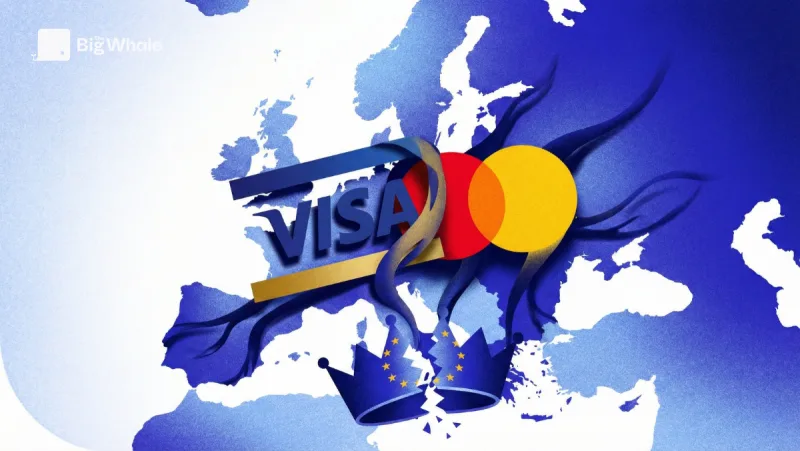
The heightened tensions between Europe and the United States seen over the last few days are putting a theoretical hypothesis back on the table: what if a US administration decided one day to suspend access to the Visa and Mastercard networks on the European continent?
Such a prospect remains unlikely, but Donald Trump's action in the White House has served as a reminder that the unpredictable has become a political variable in its own right. In this context, Europe's dependence on US payment infrastructures appears to be a strategic blind spot.
According to the Banque de France, Visa and Mastercard accounted for around 61% of card payments in the eurozone in February 2025. This dominance is the result of decades of integrating American standards into European banking systems, to the detriment of national networks which have gradually disappeared or been relegated to a marginal role.
In most countries, Visa and Mastercard have become the backbone of everyday electronic payments.
Limited local bankcard networks
France is a relative exception with the Cartes Bancaires (CB) network, which allows domestic transactions independent of the major international networks. But this system remains strictly confined to the national territory.
Other countries retain local networks (Girocard in Germany, Bancontact in Belgium, Dankort in Denmark, Multibanco in Portugal, BankAxept in Norway or Bancomat in Italy) but they do not cover all uses and are not a complete alternative to the Visa and Mastercard rails, particularly when it comes to making transactions outside their borders.
In the majority of Member States, an abrupt suspension of the US networks would result in almost immediate paralysis of card payments. This vulnerability largely explains the growing political support (particularly in Eastern European countries) for the digital euro project spearheaded by the European Central Bank.
But the digital euro will not be operational until 2029 (at the earliest), and its design is attracting fierce criticism, both from banks, which see it as a threat to their business model, and from defenders of individual freedoms.
In the meantime, what concrete solutions could emerge?
The Wero system, launched by several major European banks for instant payments through the European Payment Initiative (EPI), is not yet a viable alternative for retail.
Ingenico is now enabling retailers to accept stablecoins
It is against this backdrop that a recent announcement is attracting attention: Ingenico, the world leader in payment terminals and a flagship French company, announced this week that it is integrating stablecoin payments via the WalletConnect protocol. Millions of terminals will thus be able to accept stablecoin payments.
This is a potentially structuring development, as it opens up the possibility, as of now, of bypassing US payment rails by using decentralised blockchain infrastructures. The stablecoins currently supported include Circle's USDC and EURC (a US company, which raises questions from a sovereignty perspective) but also Tether's USDT, issued by a non-US company.
The stakes are clear: if Europe wants to reduce its strategic dependence, it must develop its own euro-denominated stablecoins. In this respect, Société Générale-FORGE's EUR CoinVertible (EURCV) is a credible initial response, but its outstandings remain limited (around €70 million) and its liquidity still embryonic.
The other initiative to watch closely is that of the QIVali consortium, which brings together around ten major European banks, including BNP Paribas, DZ Bank, UniCredit and ING. This project carries the ambition of creating a pan-European stablecoin payment solution that is interoperable and widely distributed to merchants across the continent.
The urgency is now political as much as technological. Rather than betting everything on the public digital euro, Europe would benefit from accelerating on private stablecoins in euros, capable of operating immediately in the existing commercial ecosystem. Until now, European banks have been cautious, in the absence of clear signals from public decision-makers.
This signal could come from the top of the State. Last December, French President Emmanuel Macron stressed in the Financial Times the need to develop euro stablecoins alongside the central bank's digital currency.
>> Discover our Dashboard dedicated to stablecoins