TBW - Brian Armstrong (Coinbase): "It took us three years to conclude the partnership with BlackRock".
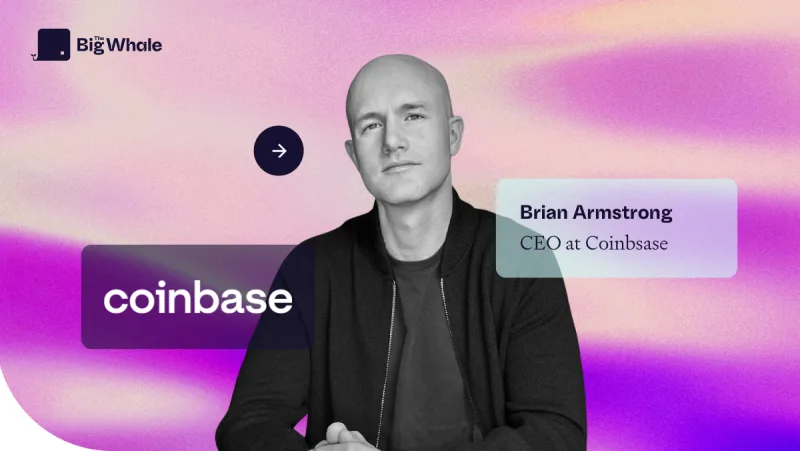
The Big Whale: You're in Abu Dhabi for Abu Dhabi Finance Week. What brings you here and what specific opportunities do you see in the UAE?
Brian Armstrong: We're very excited about investing more in the UAE. The country has become a global hub, both for financial services and, more broadly, for technology.
We recently acquired Deribit (for $2.9 billion, Editor's note), which has 130 employees in the region. We work closely with the Abu Dhabi Global Market, the Abu Dhabi regulator, as well as the Dubai regulator.
We favour countries where there is real regulatory clarity around cryptos, and the Emirates have been particularly innovative and visionary on this point. They also uphold principles of economic freedom, which fits perfectly with Coinbase's mission.
Thanks to Deribit, the Emirates have become our international hub for derivatives, and we are very likely to further strengthen our presence here.
You are a global company. What is your view of Europe, particularly in terms of economic freedom and market dynamism?
We clearly see Europe as a growth market. It's a region in which we established a foothold very early on, notably through our entity in Luxembourg, with which we work very well. In my opinion, Europe has done an excellent job in creating a clear regulatory framework with MiCA. This has given us enormous confidence to invest in the region. But you always have to find the right balance between regulation and freedom. Regulation brings clarity, but it must not turn into over-regulation. Too many constraints discourage companies from investing and put the brakes on growth. The challenge is to avoid sacrificing innovation in the name of protection.
Just where do you see the right balance between the need for regulation and economic freedom?
For me, things are fairly clear. We obviously need to prevent certain risks, such as fraud, and punish them severely. That's essential and everyone agrees.
On the other hand, we shouldn't try to eliminate market risk. Market risk means that a large proportion of start-ups fail. And that's healthy: you have to allow 1,000 ideas to emerge to have a chance of being a witness to the next big company. If creating a startup becomes too complicated, they will simply create themselves elsewhere.
In this respect, the example of the Emirates is very interesting. They have set up a "regulatory sandbox" that allows startups to get off the ground at very low cost in a supervised environment. Once they reach a certain size, they can apply for a full licence.
This is extremely clever, because a young startup that has only raised one or two million euros cannot afford to pay for expensive licences and big law firms. This type of scheme would also be very useful in Europe.
10 years ago, the crypto market was mainly retail. Today, we're talking much more about B2B. How do you see this evolution?
Effectively, crypto has become both a consumer and an institutional market, and the latter has grown spectacularly.
This is most apparent in two areas. The first concerns trading and asset holding: more and more companies want to hold digital assets on their own balance sheets. And beyond cryptos, all asset classes are gradually coming on-chain: commodities, equities, prediction markets... Everything is migrating to blockchain. Tomorrow, companies will also want to raise funds directly on-chain.
The second driver is payments in stablecoins. Cross-border B2B payments are probably one of the fastest-growing segments today. Coinbase plays a major role in this: we enable companies to pay their suppliers internationally, send invoices, integrate these payments with their accounting and tax software.
As is often the case with crypto, it's all about modernising the financial infrastructure: making payments faster, cheaper and truly global.
You're described as someone who is very product-oriented. How has the institutional shift changed your approach?
In the mass market, the product is absolutely central: it's the main interface, often the first user experience. Customer service only comes into play when there is a problem, so rarely in a positive context.
In the institutional world, the product remains crucial, but two other pillars are becoming decisive: the sales force and customer service. Human contacts are essential, even more so in crypto.
Sales cycles are also much longer. To give an example, it took us three years to conclude the partnership with BlackRock.
Today, we work with some of the world's biggest financial players - BlackRock, JPMorgan, PNC Bank, and soon Standard Chartered. We have developed real go-to-market expertise for this segment, capable of managing these long and complex cycles.
What is the greatest difficulty in working with these major institutions?
There are several factors at play. Firstly, the corporate culture: human relations are essential. Compliance is a key point, as is the solidity of the balance sheet.
The fact that you are a listed company, audited by a Big Four firm, a regulated custodian... all this counts enormously. Regulatory due diligence is very thorough, and it's this level of requirement that determines their confidence.
You spoke with Larry Fink about the convergence between TradFi and DeFi. What role do you see for Coinbase in this hybrid on-chain finance?
I think Coinbase can become the leader in tokenisation. We've already been doing it for a long time: stablecoins, "wrapped" assets like tokenised Bitcoin...
The model is simple: hold the underlying asset, then mint and burn tokens that represent it one-for-one. Trust is essential.
The other element is distribution. We have around $500 billion of crypto assets held on our platform. When players like BlackRock want to tokenise their funds, being able to distribute these products directly to our customer base - both retail and institutional - is a major asset.
We can provide technology, custody, trust... but also offer an extremely powerful distribution channel.
You often talk about making Coinbase "the everything exchange". In practical terms, what does this mean for banks and institutions?
The idea is simple: all asset classes will arrive on-chain. After cryptos came stablecoins; tomorrow, equities, commodities, public or corporate debt, perpetuals... absolutely everything will be traded on blockchain.
Why? Because it democratises access, increases liquidity, reduces settlement-delivery risk and drives down operational costs. Banks and institutions will want to exploit these new crypto rails to make their operations more efficient. Coinbase wants to be their preferred partner.
Today, we are already working with 264 institutions via our Coinbase Developer Platform (CDP), a white-label crypto-as-a-service offering.
We are constantly adding new building blocks. This infrastructure role puts us at the heart of the value chain, as more and more companies switch to on-chain.
For 2026, what are the most exciting areas for you?
We have a major product event on 17 December that will say a lot. But if I had to summarise the major trends, I would highlight three pillars:
- the "everything exchange",
- stablecoin payments,
- BASE, which is not just a layer 2 but also an application, Base App. I like to say that Coinbase represents our centralised services and Base our decentralised services.
How do you see the integration between Coinbase and the major financial players?
We are increasingly collaborating with them via our infrastructure offerings. Providing our own liquidity funds allows us to deploy our services in many countries much more quickly. This facilitates customer onboarding and the integration of innovative functionalities. Our goal: to become the crypto infrastructure layer on which traditional finance can build.
Over the next three to five years, what do you think will be the biggest fundamental shift in the crypto industry?
The arrival of all asset classes on-chain. It's a structural shift. Payments in stablecoins, in particular, still have colossal potential.
Today, around 0.5% of global GDP transits via crypto rails to purchase goods and services. In ten years' time, this could rise to 10%, or even 15%. The scope for development is immense.
Finally, BASE will remain a major focus: the ecosystem we are building around this layer 2 will play a central role in the adoption of on-chain uses.
You have been in the ecosystem for a long time. Is Bitcoin still a special asset?
Yes, Bitcoin is truly unique. It is digital gold: a rare asset with the highest level of trust. In times of uncertainty, people take refuge in bitcoin.
Bitcoin is also an asset of freedom. We live in a world of permanent deficits: when these become excessive, they lead to high inflation. At such times, Bitcoin acts as a counter-power.
It's a new gold standard, but native to digital. A sound currency is an essential foundation for progress. If your currency can be continually devalued, you have no interest in investing in the future. Bitcoin brings this solidity everywhere in the world.