TBW - Christian Leger (Franklin Templeton): “Banks must fight to earn a place in the client’s wallet”
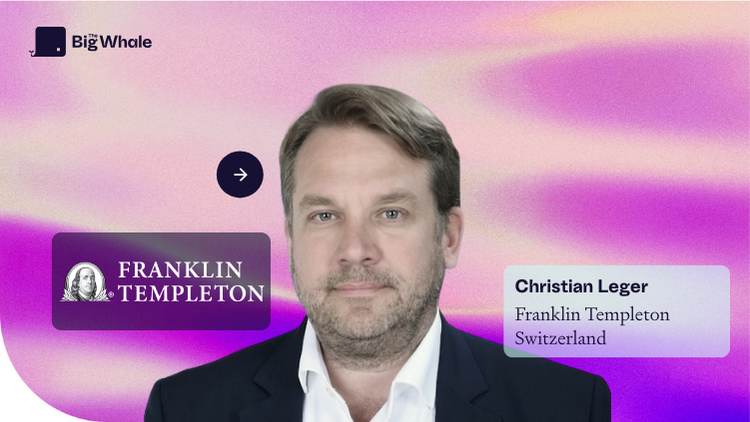
The Big Whale: At your keynote at the Web3 Banking Symposium in Zurich, you mentioned the three things banks and asset managers can no longer ignore. What are they?
Christian Leger: I am not going to focus on price predictions or the idea of getting everyone to buy Bitcoin. That is a distraction. At Franklin Templeton, however, we are convinced that payment rails are evolving and that, in the end, the best infrastructure prevails. The first point is the infrastructure itself. The second is the wallet concept, which reverses the client–intermediary relationship. The third is what Franklin Templeton is building: developments that institutions ignore at their own risk.
Infrastructure is one area where banks still allocate relatively small internal budgets. Why do you emphasize it?
Infrastructure is often boring and neglected. People chase the shiny objects first. But structural revolutions come from changes in infrastructure. History offers countless examples.
You highlight the wallet, which inverts the client–bank relationship. Can you expand on that?
In a “wallet-native” world, which I believe is coming, clients no longer live inside bank platforms. Banks must fight to earn a place in the client’s wallet. That reverses the balance of power. The key question for banks becomes: What is our purpose? What is our unique value proposition? Institutions have postponed this reflection, but excuses are running out. If the wallet becomes the center of gravity, where does the bank fit?
If you were advising a retail or private bank facing deposit outflows to stablecoins and tokenized yield-bearing real-world assets, how would you structure the response?
Own the infrastructure. Move fast. Build on blockchain. Become a provider of wallet services and tokenized securities. Do all of it, and run faster than competitors. You are no longer only fighting the bank next door. You are up against digital native businesses like crypto exchanges with millions of clients globally. Tokenized securities from non-traditional players are coming. Legacy client bases may resist, but the risk cliff is approaching faster than behavioral biases suggest. History shows repeated predictions of imminent disruption that did not always fully materialize, but quiet infrastructure shifts will prove more powerful than the volatility of any single asset’s price.
Are banks already losing market share to crypto-native custodians?
Yes, even though it is rarely discussed. The trend intensifies when Bitcoin rises, but even taking Bitcoin out entirely, the dynamic remains. A wallet compresses identity, ownership, permissions, compliance, logic, and distribution into a single interface. Financial intermediaries have fragmented these elements into supposedly defensible “moats.” Wallet adoption, especially among people under 40, represents significant disintermediation. In a geopolitically uncertain world, security, independence, and self-custody are gaining appeal. UX improvements will accelerate this movement across a broader set of demographics.
You recently launched with Binance an off-chain custody arrangement for real-world assets (RWAs). How does this work, particularly for institutional clients?
We made institutional-style money market exposure available in crypto-native environments. Our tokenization platform Benji provides “real-world” money market yields on an infrastructure fully based on blockchain. Institutions can use Benji as collateral in lending or trading operations on platforms like Binance. The mechanics are complex, but the whole setup is fully institutionalized and regulated.
Can banks compete with the continuous yield from products like Benji?
Yes, they can. They could launch similar offerings. A Zurich-based bank already has a native on-chain money market token. The issues are execution speed, institutional inertia, pricing competitiveness, and yield attractiveness.
Public vs. private blockchains for these products?
Private blockchains will not win in the long run. Public chains win thanks to ubiquity, interoperability, cost efficiency, and reliability, the same criteria that determine winning infrastructure in any era. We deploy on several public chains (Ethereum, Solana, and others) without picking winners too early. Market gravity will gradually consolidate, likely toward a smaller number of chains.
Which asset classes are most interesting to tokenize next?
Tokenize everything that can be solved from a liquidity standpoint. Private markets are compelling: they are the least liquid and where the mismatch is greatest. Solving tokenization in that segment, whether through permissioned or more open pools, unlocks the rest. Stocks, art, and collectibles are also in scope, but private equity, credit, and similar illiquid assets offer the biggest opportunity. Securitization can go very far, even to health data, but real-world operations and impacts remain. Better infrastructure reduces intermediation and frictional costs over time.
>> Discover our dashboard dedicated to tokenization
How engaged are Swiss banks in tokenization?
It varies. Some make it a priority. Others face urgent demands, risk aversion, or internal skepticism about legal and compliance hurdles. Asset managers are accelerating. It is reassuring to see competitors launch stablecoins or tokenized funds.
Is Zurich behind Paris or Frankfurt in terms of digital-asset adoption and regulation?
No. Switzerland’s non-EU status remains an advantage. EU approaches often bureaucratize tokenization, prioritizing uniformity over agility. Switzerland could have driven TradFi–DeFi convergence earlier, but it still has the opportunity. Its regulatory framework, rule of law, and geoeconomic stability position it well in a context of global uncertainty. Serious institutions favor predictability over jurisdiction hopping.
>> Discover our regulatory license tracker