TBW - Ethereum: Fusaka gives the network processing capacity on a par with Visa

In brief
- Industrial breakthrough: Scheduled for this evening, the "Fusaka" update allows Ethereum to aim for 100,000 transactions per second. A theoretical capacity greater than that of Visa, essential to absorb global financial flows.
- Operational gains: this overhaul of the infrastructure should reduce the costs of secondary networks (Layer 2) by 40 to 60% and facilitate the user experience.
- Investment thesis: The impact will not be immediate on price (no reduction in issuance). It is a fundamental long-term catalyst that neutralises the speed advantage of competitors like Solana.
In Ethereum's roadmap, there are updates that make noise, and those that build the foundations. Following "The Merge" in 2022 (the move to proof-of-stake) and "Dencun" in 2024 (the introduction of data "blobs"), Fusaka falls into the second category: a critical structural evolution, designed to take the network from an artisanal system to an industrial infrastructure.
Understanding Fusaka does not require knowing how to code, but understanding how Ethereum intends to solve its "plumbing" problem to accommodate the transaction volumes of global finance.
The heart of the reactor: PeerDAS and the end of the bottleneck
The main brake on Ethereum's expansion has until now been data management. "Layers 2" networks such as Arbitrum, Optimism or Base, which handle fast and cheap transactions, need to "anchor" their proofs on the Ethereum blockchain. Until now, this has forced the network's validators to download massive packets of data, creating a bottleneck.
The solution provided by Fusaka is called PeerDAS (Peer Data Availability Sampling).
To put it in layman's terms: imagine that to check the integrity of a book, each validator previously had to read it in its entirety. With PeerDAS, the protocol allows validators to check the book by reading just a few random pages (around 12.5% of the data). Thanks to advanced mathematical processes (erasure coding), if enough actors check different pages, the network can mathematically guarantee that the book is complete and valid.
The technical impact is drastic:
- Bandwidth requirements for validators fall by 85%.
- The data storage capacity for Layer 2 is multiplied by 3.5.
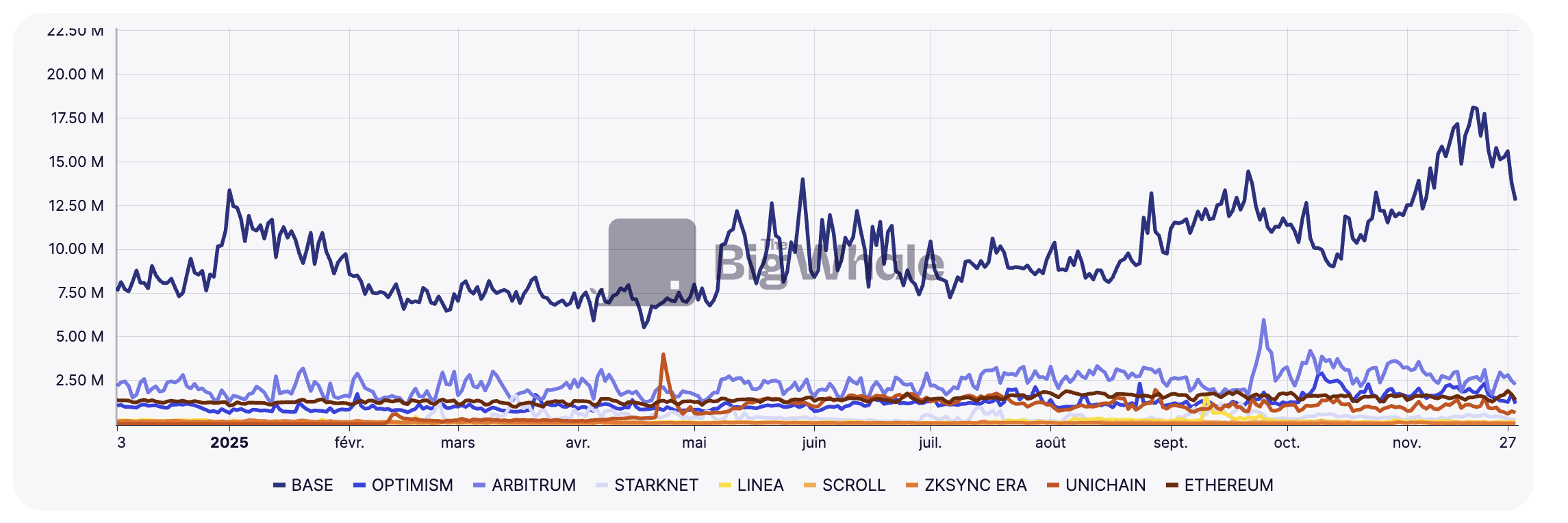
Towards "Visa"
This is where the upgrade makes sense for investors. By freeing up this capacity, Fusaka theoretically enables the Ethereum ecosystem (Layer 1 + Layers 2) to process more than 100,000 transactions per second (TPS).
By way of comparison, the Visa network processes an average of 65,000 TPS. Ethereum is no longer just looking to be a smart contract platform, but to become a settlement layer capable of absorbing global financial flows without saturation or exploding costs.
In fact, transaction fees on Layer 2, already reduced by previous updates, are set to fall by a further 40-60%, making complex DeFi (Decentralised Finance) or micro-payment operations that were previously too costly economically viable.
Other improvements: stability and user experience
In addition to raw performance, Fusaka introduces elements of comfort:
Cost predictability: A new "fee reserve" mechanism for data blobs has been integrated. Instead of experiencing extreme price volatility during peaks in usage, the network will smooth out costs, providing better accounting visibility for Layer 2 operators.
Security and UX: The integration of the secp256r1 standard (via EIP-7212) is a discreet but powerful advance. It enables native compatibility with the secure enclaves on modern smartphones (Apple FaceID, Android). Ultimately, this means that signing a crypto transaction could become as simple and secure as validating an Apple Pay payment, removing the friction of complex private keys for the end user.
What impact on the ETH price?
Short-term: No supply shock.
Unlike the EIP-1559 upgrade (which started burning ETH) or Merge (which reduced issuance), Fusaka does not directly affect token scarcity (tokenomics). On the contrary, by lowering costs for Layer 2s, it could even marginally reduce the quantity of ETH burnt per transaction initially. We should therefore not expect any "automatic" and immediate bullish mechanics on the day of the update.
Long term: A fundamental catalyst because Fusaka is a powerful vector of fundamental value.
Competitive advantage: By achieving 100,000 TPS speeds while remaining decentralised (thanks to lower hardware requirements for nodes), Ethereum neutralises the main selling point of competitors like Solana: speed.
Network effect: By making the infrastructure capable of hosting consumer and institutional applications without friction, Ethereum secures its leadership position. The more activity on Layer 2, the more demand for ETH (needed to set security on the main layer) stabilises on the upside.
Conclusion: Fusaka may not trigger an instant bull run, but it validates the investment thesis of Ethereum as the universal settlement layer of the Internet.
>> Check out our Ethereum Dashboard
>> Briefing - The state of Ethereum in Q3 2025