TBW - Jan-Oliver Sell (Qivalis): "We are building the European infrastructure for the euro on-chain"
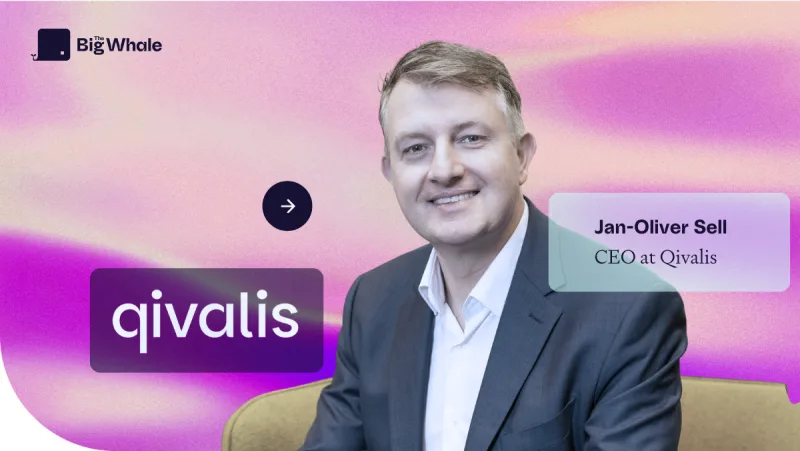
The Big Whale: Qivalis arrives with a lot of ambition. Can you simply summarise the project's objective and explain why it is emerging now rather than two or three years ago?
Jan-Oliver Sell: The objective is pretty clear: we are building a euro stablecoin issuer backed by an open consortium of European banks (BNP Paribas, ING, Unicredit, etc.). Behind this initiative is a growing awareness on the banks' side that blockchain rails are becoming (and will become increasingly) more efficient than traditional fiat payment rails.
So we need a solid interface between the fiat euro currency and these new on-chain infrastructures. That's exactly what we're putting in place: a MiCA-compliant, 100%-backed euro stablecoin with all the regulatory and operational infrastructure to enable it to be used on a European and international scale.
If the project didn't come about sooner, it's largely because the banks first had to come to an agreement among themselves. They have actually been working behind the scenes for two to three years. It took time to align interests, educate internally and reach a sufficient level of conviction about the strategic need for an on-chain euro.
At the same time, the European political context around stablecoins was unclear: between the ECB's discussions on the digital euro and the lack of a clear framework, many players hesitated. Today, MiCA is bringing regulatory clarity, geopolitical tensions are reinforcing the issues of monetary sovereignty, and the ECB is gradually clarifying its vision. This alignment finally makes it possible for traditionally cautious institutions to make an investment decision.
Why a consortium rather than a stablecoin backed by a single bank, as has been seen elsewhere? Some might see this as a way of diluting responsibility or slowing down the movement.
The intention is exactly the opposite. We're not looking to create a banking product, but a piece of European infrastructure.
The main challenge of a stablecoin, beyond the technology, is distribution. How do you get a new on-chain euro adopted in the face of the dominance of dollar stablecoins? An isolated player, even a major bank, has limited distribution capacity. A consortium, on the other hand, makes it possible to aggregate multiple channels, use cases and balance sheets.
Each member bank develops its own uses on these common rails: cross-border payments, settlement-delivery of tokenised assets, cash management, etc. This creates an organic distribution engine that is much more powerful than that of a single issuer.
We are inspired by successful European examples such as Amadeus in the airline sector: competitors joining forces to create a neutral, independent infrastructure, which then becomes a market standard. Qivalis is designed in this way: an independent entity, owned by banks, but operated as an open infrastructure.
"The needs of consortium members are very different"
When you talk to new banks about joining the consortium, what are the main difficulties?
The first reality is the heterogeneity of the European banking market. The level of maturity when it comes to digital assets varies enormously. Some banks already have dedicated teams, pilot projects and, in some cases, digital bond issues. Others are still at the exploratory stage.
Our role is therefore first to understand where each bank is in its digital assets journey. Joining the consortium does not have the same meaning depending on whether we are looking for an immediate use case or a medium-term strategic option.
We also need to distinguish between two levels of commitment: shareholders, who participate in governance and capital, and future stablecoin distributors or users, who will not necessarily be shareholders. The consortium is open, but it must remain coherent and operational.
How would you describe the level of crypto adoption among European banks today?
It's a very broad spectrum. Some of the banks we work with are ready to use stablecoin as soon as we obtain our licence. They have already identified concrete use cases, sometimes linked to the tokenisation of financial assets.
For example, some are planning to issue tokenised bonds and settle them in stablecoin euro almost immediately. Others are focusing more on cross-border payments or the custody of digital assets.
At the other end of the spectrum, some banks are still structuring their overall digital asset strategy. With them, we are having much more fundamental discussions: how to integrate blockchain into their architecture, what products to develop, where stablecoin can fit.
The consortium is creating a collective framework, but we are also having very detailed bilateral discussions with each bank. The needs are very different, and this is precisely what feeds the diversity of future use cases.
When do you plan to officially launch stablecoin?
The timetable mainly depends on the regulator. We have applied for an electronic money institution (EME) licence from the Dutch central bank (DNB), which is our supervisory authority.
The process usually takes between six and nine months. Our aim is to be technically and operationally ready before the licence is obtained, so that we can start issuing and using stablecoin immediately once the authorisation has been obtained. We are therefore aiming for an operational start-up around the second half of the year.
"The more finance becomes tokenised, the more the logic of settlement in euros will be imposed"
Among the banks in the consortium, do any already have their own stablecoin, or an advanced project in parallel?
At this stage, no bank in the consortium is issuing its own stablecoin within Qivalis, since the very idea is to create a joint issuer. But some banks are running other initiatives in parallel, and there is not necessarily any incompatibility.
For example, some institutions have been able to explore other consortia or look at what is being done by players like Société Générale-FORGE, or initiatives in Germany around other projects. I think there is room for several euro stablecoins.
The potential market is huge. If you look at the global flows of stablecoins, the euro today weighs something like 0.2% of flows. That's extremely small. Conversely, if you look at fiat flows (cross-border payments, reserves, purchases of digital assets, etc.) the euro represents more like 20% to 25% depending on the metrics. The gap is enormous.
In other words: the euro has a natural place in this ecosystem, but it hasn't yet found its on-chain rails. For me, it's not a question of "if", but of "when". European players, European users and European businesses simply need to operate in euros. And the more finance becomes tokenised, the more the logic of settlement in euros will take hold.
>> SG-Forge is to launch a dollar stablecoin, a world first for a banking group
You place a lot of emphasis on the idea of "infrastructure". In practical terms, what are you going to deploy the stablecoin on? A public blockchain such as Ethereum? Or more institutional networks like Canton?
Our position is clear: we are building an open token, a public euro stablecoin, intended to be widely used in the ecosystem. It's not a closed token reserved for a few institutions on a private network.
So yes, Ethereum and the EVM universe are a natural starting point, because that's where most of the liquidity and live use cases are today, particularly in DeFi and the crypto markets. If you want to create an on-chain euro that counts, you need to be where the activity is already happening.
But that doesn't mean we're ruling out other architectures. We want to build Qivalis as an omni-chain token. If a shareholder bank or an institutional player has a massive use case on a network like Canton, or on another more "permissioned" infrastructure, we will obviously study it. It's not binary.
There's a permanent balance to be struck: moving forward quickly, delivering a usable product, fetching liquidity where it is, while retaining the ability to serve institutional use cases that sometimes require specific environments.
What do you think will be the main use case at launch? Payment? DeFi? Tokenisation?
Our reading is that you have to be pragmatic: start where stablecoins are already used, and where the behaviours exist.
The first market is the crypto ecosystem: trading, DeFi, lending/borrowing, exchanges, infrastructure. There is already a demand for stablecoins, there are already users, there are already protocols. Our responsibility is to help create a genuine "on-chain euro ecosystem" within this world.
Then there is the subject of cross-border payments. Today, this market is largely dominated by dollar stablecoins. But with the geopolitical context and the growing demand for alternatives, the euro could become more attractive for these uses.
Finally, the third pillar: the tokenisation of assets in the broadest sense. Whether we are talking about real-world assets (RWAs) or tokenised financial instruments, a layer of regulation is needed. And European players tokenising European assets will want to settle in euros.
Our ambition is to provide an "institutional grade" settlement layer, whether on a public blockchain or on more dedicated infrastructures. And to be available when these use cases reach maturity.
"We need to be able to build fast, with solid governance, but without being paralysed by constant arbitration between 30 or 40 institutions"
Will the customers of a shareholding bank (BNP Paribas, UniCredit, etc.) have any particular advantage or specific rights over stablecoin?
No. This is a key point: we are an independent entity. The banks are shareholders, but they have no "special rights" over the product compared with any other authorised user or distributor.
This is important for us, and it's important for the regulator: our independence is a central issue. We need to be able to build quickly, with solid governance, but without being paralysed by constant arbitration between 30 or 40 institutions.
This is not to say that banks will not have a structuring role: their distribution capacity and potential use cases create an obvious competitive advantage. But stablecoin itself is designed as an open infrastructure.
There are already several MiCA-compliant euro stablecoins. How are you making up for this delay?
That's true: there are already regulated euro stablecoins, and around fifteen (or even twenty) players who have obtained approvals or launched products within this framework.
But we arrive with a different configuration: a structure designed from the outset as a European infrastructure supported by a banking consortium, and therefore with distribution and institutional integration capabilities of a different order.
Our challenge is to choose the right priority use cases, those that create liquidity, Total Value Locked (TVL), and a network effect. Hence our simultaneous discussions with banks, DeFi platforms, distributors, and future market makers.
MiCA requires a significant proportion of reserves to be deposited with credit institutions. How will Qivalis select its custodian banks?
We are setting up an independent treasury policy, with a very clear framework, and then we will launch an open process in practice. The shareholder banks will obviously be part of the discussions, but there is no obligation for them alone to hold the reserves.
The choice will not be purely financial. There is a strong technological and operational dimension: the ability to provide data in real time, to interface their systems with our reporting needs, to manage liquidity in an environment where the token operates 24/7 while the banking world remains largely on business hours. This asymmetry is a real asset-liability management issue for a stablecoin issuer.
So we want to treat this as any serious independent issuer would: objective criteria, diversification, operational robustness.
"Build a portfolio that balances return, liquidity and duration"
At the outset, will reserves be in cash only? Or are you also planning to hold securities?
We'll start with cash, which is the simplest way to get started and to guarantee maximum liquidity. Then, as outstandings grow, we'll look at high-quality liquid assets (HQLA).
In Europe, it's a little more complex than in the US, where the Treasuries market is extremely deep and homogeneous. But the idea remains the same: build a portfolio that balances yield, liquidity and duration. It's not a purely yield logic, it's also a logic of resilience in the event of massive redemptions.
Just how do you guarantee the 1:1 peg in the event of a wave of redemptions?
That's precisely why MiCA has been structured prudently. The requirement for a high proportion of immediate liquidity and highly liquid assets is designed to absorb stress scenarios.
Our portfolio will be constructed using a matrix that takes into account several parameters: the market depth of the assets, their liquidity under stress, their maturity, and of course their yield. Yield is important ,it's our main source of income, but it can never be at the expense of liquidity.
A stablecoin is first and foremost a product of trust. The ability to cope with rapid and large redemption requests is central.
Qivalis remains a business. The yield on reserves is your main income. How do you see the balance between growth, costs and profitability?
We obviously have a financial plan, shared with our shareholders. But I think the main risk is not so much growing too slowly as... growing too fast.
If adoption is strong and rapid, this implies increased requirements for regulatory capital, infrastructure, teams, controls. Scaling up can become a challenge in itself. So we need to be prepared for both scenarios: gradual growth or very rapid adoption.
Shareholders understand that we are building a long-term infrastructure. There is a strategic vision behind the project. That doesn't mean we can ignore financial discipline, but we're not in it for the quick win.
The key issue remains liquidity. How do you create market depth for a stablecoin euro?
This is probably one of the biggest challenges. And that's why DeFi is essential in our strategy.
Today, many European users who want to generate on-chain yield go through stablecoins in dollars. They get 6%, 7%, sometimes 8%... but at the same time they suffer the exchange rate risk. Over the last twelve months, the dollar's depreciation against the euro has sometimes wiped out a good part of the return.
There is therefore a strong economic argument for a euro stablecoin used in DeFi. But for this to work, you need a real ecosystem: lending, borrowing, DEX, structured products, yield strategies. The yield must come from on-chain finance itself, not from a permanent subsidy from the issuer.
We cannot distribute our yield directly to holders. So the only sustainable path is to help create a DeFi euro ecosystem deep enough to generate native yield. And that won't happen alone: it's a collective undertaking, with other issuers, protocols and market makers.
"Obviously, if other major currency zones allow remunerated stablecoins, that creates competitive pressure"
In the United States, the debate over redistributing yield to stablecoin holders is coming back strongly. China is testing forms of remunerated digital currencies. What is your position?
Europe has made a clear choice with MiCA: no direct distribution of yield by the issuer. But it is clear that if other major currency zones allow interest-bearing stablecoins, this will create competitive pressure. In the long term, Europe will probably have to adapt to market developments.
Our current position is to build a viable model without direct redistribution. But we remain attentive to regulatory and international developments.
With so many banks involved, how is governance structured? How do you guarantee Qivalis' operational independence?
We have built a governance structure very similar to that of a conventional company, but adapted to our context.
The banks are shareholders on an equitable basis. With each new entry to the capital, the shareholding of the others is diluted, as in any company. But the operational side is in the hands of a dedicated management team whose role is to build and execute.
Above that, we have set up a supervisory board made up of half independents and half bank representatives, with regular rotation on the bank side. Key point: the chairmanship is held by an independent person, and this rule is unbreakable.
Independence is an important issue for the regulator. The Dutch central bank is keen to ensure that Qivalis is not simply an extension of a particular bank, but an autonomous and solid entity.
Do you work with other large infrastructures such as SWIFT or similar international initiatives that are developing blockchain projects?
Yes, and this is a direct effect of the consortium. Having major European banks behind us naturally attracts discussions.
We exchange with infrastructures like SWIFT, but also with comparable initiatives in other currency zones. There are, for example, yen stablecoin projects led by consortia of Japanese banks, or similar initiatives in Korea.
So there is a global dialogue taking place around regulated bank stablecoins. The issue goes far beyond Europe: it's about understanding how these new forms of programmable money can interconnect on an international scale.
>> SWIFT launches on Linea to test its "on-chain "model
"Circle remains a private US company"
Do you see Qivalis as a competitor to the ECB's digital euro, particularly in its wholesale version?
I don't see it as head-on competition, but as different layers of the same monetary architecture.
The wholesale digital euro, as envisaged today, would be aimed at a restricted circle of institutions and would probably not be deployed on public blockchains. It's a central bank infrastructure rationale.
We're building a stablecoin that can be used on public blockchains, integrated into DeFi, in asset tokenisation, in cross-border flows. These are different uses, with different constraints.
And there is also a question of timing: a central bank project naturally takes longer. We can move faster on certain use cases, particularly where innovation comes from the market.
Do you consider Circle, with its EURC, to be your main competitor?
Probably, yes. EURC is now the most internationally visible euro stablecoin.
But Circle remains a private US company. In the current geopolitical context, many European players see a strategic interest in having a strong European alternative.
For me, a robust and widely used euro stablecoin is an element of European strategic autonomy. If blockchain rails become dominant for payments and settlements, and the euro has no credible on-chain presence, the risk is a gradual dollarisation of digital uses.
We can already see this in DeFi: a large part of the business is done in dollars. In the long term, this could become a systemic issue. Having a strong, interoperable on-chain euro, supported by European institutions, is an important piece of monetary sovereignty in the digital world.
>> Jeremy Allaire (Circle): "We want to be at the centre of the global financial system"
Do you have a capitalisation target at launch or after a year?
It's very difficult to give a precise figure, because it will all depend on how quickly institutional use cases materialise.
We're already seeing tokenised bond issues in Europe worth several hundred million euros. If we become the settlement layer for this type of transaction, we can quickly reach significant sizes.
But beyond market finance, I think the real potential in the medium term also lies with corporates. Imagine European industrial groups using a euro on-chain to optimise their cash flow, pay their suppliers in near-real time, or invest in tokenised money market funds with settlement cycles of a few minutes instead of several days.
The sticking point today is often accounting: under IFRS, the treatment of a stablecoin is not yet clearly defined as a cash equivalent. If this clarification comes, it could unblock a whole new segment of demand on the corporate side.
How far have you got with the team and the next regulatory steps?
We started in October and there are now around twenty of us. The aim is to build a solid team, combining banking profiles and crypto experts.
Our priorities are very clear: finalise the technical build, put in place all the compliance processes, make progress with the Dutch regulator on the EMI licence, and at the same time sign agreements with future distributors, platforms and liquidity partners.
We are literally building the plane in flight: technology, compliance, business development - everything is moving forward in parallel. The idea is to be ready on all fronts by the time the licence arrives, so that stablecoin can be launched immediately and in good liquidity conditions.
>> Discover our dashboard dedicated to stablecoins