TBW - Jean Meyer (Deblock): "Commerzbank is not the only bank interested in our business".
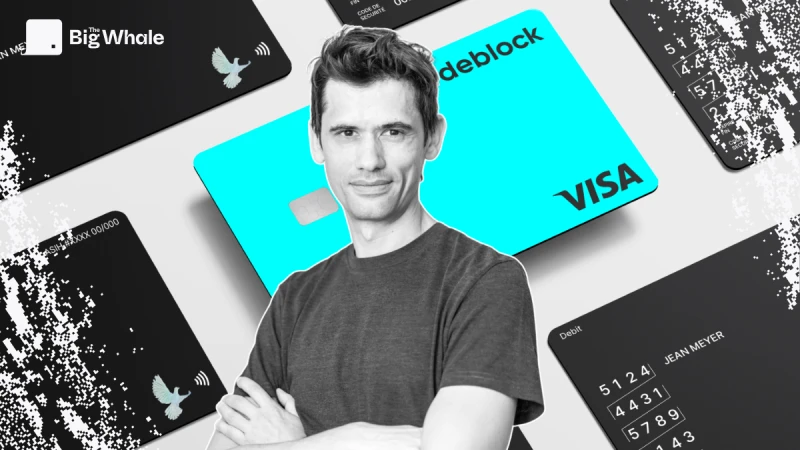
The Big Whale: It's been a big week for Deblock. You announced a €30 million fundraising round on 19 November, followed by the launch of your token the next day. Let's start with the first piece of information: what are you going to do with this Series A?
Jean Meyer: There are two essential aspects. The first concerns our product line. Many fintech functionalities require capital tied up in equity. It's a classic case: if you launch a Visa or Mastercard card, they ask you for collateral. And the more customers' card business grows, the more you have to match it. We also have several innovative products in the pipeline that require liquidity. Raising funds will enable us to move forward more quickly.
The second aspect is marketing: we need to make Deblock known to as many people as possible. We want to accelerate in France, but also internationally. In particular, we're preparing a major launch in Germany and Austria in the first quarter of 2026. If things go well, we'll expand to other European markets.
Deblock has raised a total of €56 million in funding since 2022. How do you explain this attractiveness to investors?
We raised €12 million at the very beginning when there were just four of us, in a post-FTX market where nobody was funding Web3 projects any more. And today, when almost all fund capital is going into AI, successfully raising €30 million in consumer-oriented fintech is still a small feat.
But Deblock has solid metrics, extremely strong growth, and above all a unique technological architecture. Unlike 99% of fintechs, we decided to build everything ourselves: KYC, core banking, payment rails...
It took longer and was much more difficult, two years of development, but today we have much higher margins than our competitors. And that pleases investors, because these margins allow us to reinvest more in growth. Over the first nine months of the year, we quadrupled our revenues in France alone.
You announced the launch of your BLOCK token on Thursday, what will it be used for? To pay fewer fees?
We could have gone for a reduced fee mechanism, but we chose to focus on staking and above all cashback. Unlimited cashback. Our customers can easily get 5%, which is virtually unheard of in France. We hope to be able to launch this offer in the first quarter of 2026.
What amounts will have to be staked?
Things cont to be refined, we will be offering 3% cachback from €500 staked.
What are your tokenomics? Are there any burn or buyback mechanisms?
We remain flexible on buyback to seize the best opportunities. Our main strategy is based on the interchange rate, which we recover in full because we are a direct member of Visa.
Unlike other players such as Metamask or Ledger, who go through an intermediary (a "bin sponsor"), we receive these commissions directly. We then redistribute them to our users in the form of cashback.
In practical terms, when you pay abroad with your Deblock card, the merchant pays a 1% commission that goes to us - and not to the issuing bank. In France, this commission is lower (0.1%), but the principle is the same.
Instead of paying out this cashback in the traditional way, we distribute it in BLOCK tokens. We then use this income to buy tokens on the market and destroy them. It's a virtuous circle: the more our customers use their card, the more commission we generate, and the more tokens we buy back and burn.
What is your overall objective with this token? Aren't you worried about damaging your image if it collapses?
Many companies issue a token to protect their cash flow, but we've just raised €30 million. We have three years of runway ahead of us. we have no pressure.
We wanted to announce the project after the raise, precisely to show that we don't need it financially. It's a loyalty programme, like American Express or Revolut Rewards. The real question was: would we do it with centralised points or would we do it with points that have liquidity on a secondary market? We chose the second option.
But if the reactions are too negative - and we see some saying "it's a shame to waste a beautiful brand with a token" - we'll stop. If the community doesn't want it, we won't do it. It's really for them.
Is there an allowance for investors or the team?
For the team, yes. For investors, no. No allocation.
We had VCs very excited about the token during the raising. The first question they asked was, "How much of the token is reserved for investors?" And our answer was zero. The second we said zero, they pulled out. Which is perfect, because we didn't want that kind of investor.
What will be the team's vesting period?
36 months is pretty much the norm.
"Trust isn't won with ultra-targeted marketing campaigns, but by occupying the global space, by becoming a household name"
You recalled your marketing challenge at the start of our exchange. Your strategy was fairly aggressive at the start of the year, with billboards in the Paris metro and TV ads... Did these investments pay off?
Recognition marketing never pays off in the short term. If you measure the immediate return on a poster campaign or a TV advert, you're bound to be disappointed: the acquisition cost is too high and the impact too diffuse. That's not the point.
The point is to build a brand. In fintech and even more so in crypto, trust is THE number one criterion. And this trust is not earned with ultra-targeted campaigns, but by occupying global space, by becoming a household name.
The effects take time to appear, sometimes six, nine or twelve months later, in the form of more natural conversions, stronger word-of-mouth and an acquisition cost that mechanically drops.
This is a logic that I've already observed in the dating sector, which is my old industry (he founded the Once app in 2015, bought out in 2021 for $18 million, editor's note). At the time, Bumble was investing heavily in brand awareness, while others were just doing pure performance. Two years later, they cut off communication... and found themselves with 90% organic registrations. This kind of delayed effect really does exist.
You were also a sponsor of the TV talk show Quotidien (TMC) at the start of the year, which created some unease when its columnists subsequently attacked the crypto sector heavily. With hindsight, it was a mistake. We did it opportunistically: our persona is young, urban, 18-35, so Quotidien ticked the boxes... but in fact it didn't. In the end, their audience doesn't really seem interested in crypto and it was also a fairly costly operation.
And there was another, more sociological element: as we had already sponsored media perceived as right-wing oriented, we were afraid of being labelled as a "right-wing box". So we wanted to 'balance things out' with a left-wing media outlet. It was a miscalculation in hindsight.
You now have 70 people in the team and are aiming for the 100 mark. For an application launched in 2022, that might seem like a lot. Why such a large team?
People completely underestimate what a regulated fintech requires in terms of resources. The first block is compliance. We're currently in the middle of a three-month inspection by the regulator, ACPR. It's a standard procedure: all electronic money institutions and MiCA players go through it. It's a colossal task.
Then there's the engineering. When you decide, as we did, to build everything in-house, you need a very large technical team. We have around thirty back-end engineers, which may seem huge, but it's the price of technological independence and the promise of better margins in the long term.
Alongside that, you need teams to manage payment cards, shipping, etc. And also a very large customer support team. Many people think that support is three people in a corner with a chatbot. In reality, at Deblock, we have 20 to 25 people working full time on support alone.
You're talking about 300,000 customers who have filled in their KYC and 100,000 monthly active customers (at least two transactions per month). Where do most of your revenues come from: crypto purchases/sales or premium subscriptions?
Mostly subscriptions (between €10 and €14.99 per month depending on the length of the commitment). Transactions come second.
Our goal now is to scale up. In concrete terms, we want to go x10: from 100,000 to 1 million active users and from 300,000 to 3 million verified accounts. France remains the key market in this first phase.
"We've received a huge number of enquiries from other very large European banks"
Your investors include the venture capital fund of German bank Commerzbank. Does this open the door to an eventual takeover by a bank?
Our ambition is to become the biggest player possible. If one day there is to be a deal, I'd prefer it to be the other way round and for us to be the ones to take over a bank.
What is certain is that Commerzbank is not the only one interested in us. We have received a huge number of enquiries from other very large European banks. Some groups have even sent their M&A teams to our offices to find out what they're missing. When a bank starts to notice more and more payment volumes from a new player in its systems, it naturally asks itself questions.
Will traditional banks favour takeovers of players like Deblock, or instead create their own from scratch offerings?
We've already experienced this with the 'classic' neobanks. Many banks chose to launch their own internal spin-offs. But if you look at the figures, it wasn't necessarily the right bet financially speaking. BforBank, for example, probably cost Crédit Agricole more than it would have to buy a neobank like Lydia. Nonetheless, some senior managers are keen to see this happen.
However, I think we will also see consolidation through M&A, with banks buying up certain pure players. And we will also have to reckon with the American or foreign heavyweights who will need regulated access to the European market.
"There is a real demand for offering fixed returns via DeFi, and we are actively working on this"
You have been offering returns to your customers via the Morpho decentralised finance protocol (DeFi) since June. What is your assessment of this service?
We have exceeded €20 million in deposits. The results are positive, but we can do better. What we've noticed is that there's a real demand for fixed returns: people want to know how much they're going to earn, whereas until now it's been variable (around 5.8% annualised on stablecoins according to the Deblock website's communication, editor's note).
This is something we're actively working on. There are several avenues for achieving this, notably via tokenised money funds like Spiko's, which offer excellent predictability (they are backed by sovereign bonds, editor's note).
>> The DeFi revolution is gradually being integrated into fintechs
Some Morpho vault managers take considerable risks to maximise returns, sometimes to the detriment of fund security. How do you select the vaults you offer your customers?
We work directly with the Morpho teams and we don't take any unnecessary risks. It's simple: we prefer to offer a lower but perfectly secure return rather than a very attractive but risky return.
That's why we focus on the bluest-chip vaults, essentially those in EURC stablecoins and USDC, which rely on the most serious managers in the market, such as Gauntlet. They offer measured returns, paid out in native tokens, but above all they offer maximum security.
>> Risk curators: at the heart of loan market management in DeFi
If despite everything an incident occurred, how would you be able to react?
From a legal point of view, the responsibility does not lie with us. The regulator itself would recognise that the funds are in self-custody and that the user has accepted the risks inherent in DeFi that have been presented to them. But in practice, this would be untenable. We would be obliged to assume part of the loss, if not all of it, to protect users and preserve the brand. That's why we're ultra-conservative.
Could you launch a bespoke Morpho vault reserved for your customers?
We're seriously thinking about it, but to do that we need to be able to deploy quite a lot of cash. Our fundraising could help us achieve this.
"Non-custodial isn't an argument in itself, it's a way of offering better services"
One of your main arguments is that you offer a non-custodial wallet that guarantees your customers that they are the only ones in control of their funds. Is this really a decisive factor in convincing the general public?
Honestly, no. Apart from those in the know, the general public is not really interested. Apart from those in the know, the general public isn't interested in any of this. What interests them is much simpler: being able to pay, earn money and access liquidity. All the world's fintechs revolve around these three needs.
But to achieve this more effectively than the others, non-custodial is not an argument in itself, it's a means of offering better services. Thanks to it, you can use crypto rails that have no limits.
This means that there is no freezing of funds for several days if you want to make a transaction to another wallet. No one to ask you if it belongs to you or not. Want to send a million USDC stablecoins to a relative in Peru at two in the morning? On Deblock, you can do it instantly. And it's only possible because the user really does have the access key to their wallet and total control over their funds.
You recently had a heated exchange with an executive from your competitor Trade Republic on X (ex-Twitter). What do you criticise them for in the way they present their new "crypto wallet"?
The problem is simple: they present their product as a "real crypto wallet", which is factually false. A crypto wallet means just one thing: self-custodial, i.e. a wallet whose keys you control. That's what we offer with Deblock. With them, that's not the case. They deliberately play on the ambiguity between "custodial wallet" and "self-custodial wallet", and that misleads the consumer.
They also claim to be in "cold storage" without having access to the funds. Here again, unless proven otherwise, this is not true: a custodial cold storage remains custodial.
You're being harsh. It's not scandalous to talk about a "wallet" as long as you can receive and send cryptos. It's a fairly broad generic term...
In reality, very few players present themselves as having a "wallet" when they don't offer a self-storage solution. Kraken, for example, never says that they offer a wallet on their exchange platform. They have a separate application, Kraken Wallet, which is in fact a real wallet. You have to be demanding because these terms have a very precise meaning in the industry and for customers.
Your DeFi integrations are also a marker of differentiation, but how relevant is it to the general public?
Everyone can buy crypto or shares on a traditional platform. But we can go much further, because we're directly connected to DeFi. With Morpho, we've started to offer returns that traditional finance can't. Tomorrow, we intend to open up the whole range of DeFi opportunities in an accessible and integrated way.
A loan arranged via DeFi is a perfect illustration of the frictions we are resolving. In practice, getting a loan through this channel is quite complicated if you have a traditional bank. You receive USDC, you have to convert it into euros and send it to your bank account, justify the flows to your banker, explain that a bitcoin you hold has been used as collateral on a blockchain protocol to open this line of credit...
On Deblock, you send your bitcoin on the protocol of your choice and you get stablecoins that can be converted into euros on your current account in the app with one click. It doesn't take more than a few seconds to get your loan back and use it in the real world.
How do you judge competitors like EtherFi, which present themselves as "DeFi neobanks" accompanied by a payment card?
To be honest, we're not playing in the same category at all. These players are "pure DeFi" and are not regulated. They don't have access to fiat rails. And for the customer, as long as you don't have full access to traditional payment networks, you can't be a real neobank, even if you have good crypto services.
So, of course, you can have a card, yes, but it will be limited in spending: €500, €3,000, and then it stalls. As soon as you start using these alternatives as your main account, you realise that it's not enough.
You need an IBAN, access to the SEPA network, a card that can be used everywhere, with no ceiling reduced to a minimum. And that's something only regulated players operating as genuine fintechs can offer.
>> EtherFi: How relevant is the business model of this DeFi neobank?
Despite their very limited development, do you think that euro stablecoins have a future in payments in Europe?
They clearly have a future, but it is still built on a fragile economic foundation. Dollarised stablecoins are exploding because their model is profitable. In the United States, issuers can invest reserves in Treasury bonds and generate comfortable returns. In Europe, issuing a stablecoin means tying up a huge amount of capital. This greatly reduces the profitability of the reserves. Nevertheless, I think we'll get there in the end because the growth of this instrument is too great to ignore.
The use cases are obvious, such as intra-company payments when you have to manage numerous flows in different currencies with foreign subsidiaries. And that's just one example, globally all B2B could benefit from their advantages. Many banks are also beginning to understand that if they converted part of their balance sheet into this form, it could help to reduce the level of capital they have to hold.
As for Deblock, we would like to offer more DeFi services backed by euro stablecoins, our customers are European, so it makes sense. But at the moment we're very limited because their liquidity is insufficient... So we're forced to go through the dollar, and that's a real shame.
>> Discover our Stablecoin Dashboard