TBW - Joris Delanoue (Fairmint): "Global finance will shift on-chain within two years"
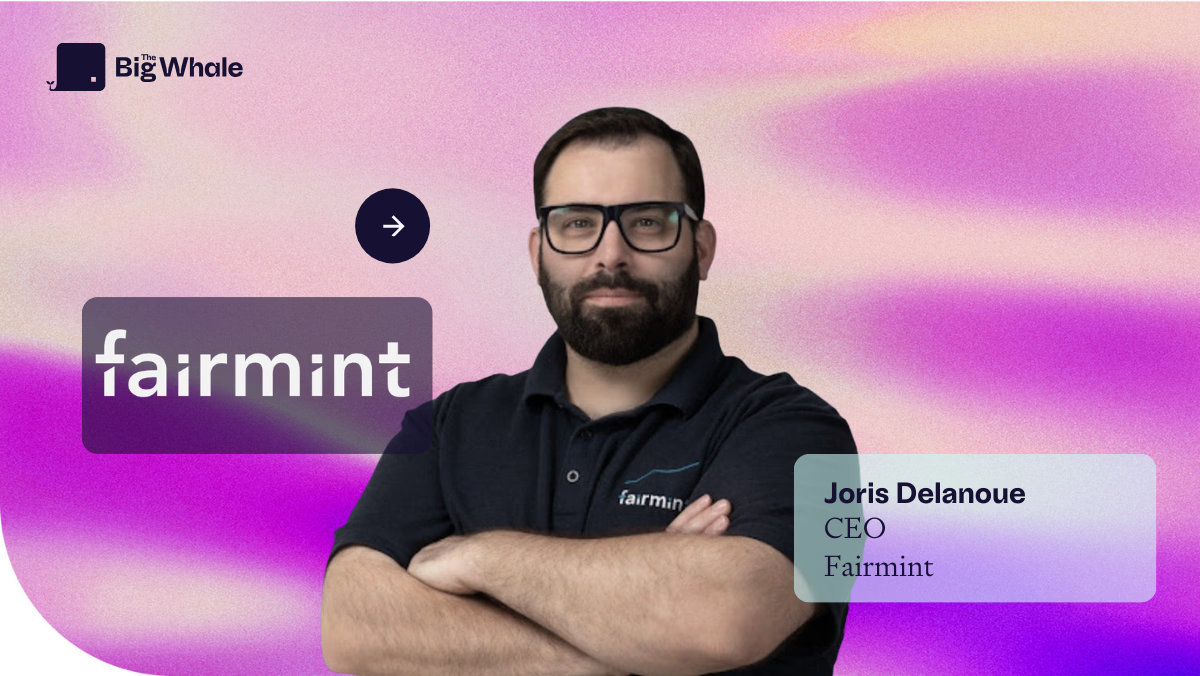
The Big Whale: After several years of a "crossing the desert" phase for equity tokenization, we’re seeing a sudden, sharp acceleration, particularly in the U.S. How do you view the current market dynamics?
Joris Delanoue: Things are looking up; the market is finally opening. We’ve been through a true desert crossing—a tunnel where we couldn't see the exit—but today, the light is clearly there. What’s happening in the U.S. right now is incredible, reaching a level we couldn't have even imagined a year ago. I am in daily contact with the DTCC (Depository Trust & Clearing Corporation); if you had told me that last year, I wouldn't have believed you.
At Fairmint, we are very mission-driven. We didn't build this structure to give up after a year. We initially thought the shift would take two years; it took eight. But we are finally witnessing the market overhaul right before our eyes. The largest TradFi players have decided they won’t be disrupted. They’ve understood the technology. They aren't interested in "shitcoins" or Layer 1 governance tokens. Instead, they want the tech to usher in a new era: one of more fluid, faster markets with instant settlement. It’s the application of ten years of crypto market observations to actual capital markets. The shift is now inevitable, and it will happen within a year or two.
Is this acceleration industry-wide, or is it still confined to a specific niche?
We’ve moved from seven years of Proof of Concepts to a phase of immediate demand. Today, smart contracts are being developed specifically to interconnect. In my view, that was the main hurdle, and it has just been cleared. Once the infrastructure is ready and trust is established—whether we’re talking about a billion or a trillion dollars—everything shifts.
The real issue is execution: where will the financial transaction be settled, regardless of the asset? The question of the "ledger" is too rarely addressed by observers, yet that is where the future of finance is being played out.
The SEC’s "no-action letter" last December is often cited as the real catalyst for the DTCC. Do you share that analysis?
Absolutely. It was a way of telling the DTCC: "We are open for business." In practice, whether a financial security is on paper, recorded in a traditional data center account, or on a distributed ledger, nothing fundamentally changes.
That letter was a very subtle political message. The DTCC is owned by its members: transfer agents, broker-dealers, and exchanges. Many of these members were skeptical, especially after investing heavily in solutions that hadn't yet borne fruit. The SEC sent the necessary signal to tell them: "Now we go, or you'll be left behind." Without that regulatory backing, the American market would have risked a slow erosion.
“Banks are now all-in”
Was the risk, then, losing control to international competition?
There isn't really competition in terms of liquidity and global capacity when compared to the U.S. The risk was primarily temporal and political. There’s a realization that the political calendar could become hostile in the coming years. Consequently, players decided to accelerate now to safeguard these advances.
I had a very interesting discussion during a closed-door roundtable with Hester Peirce (SEC Commissioner). She acknowledged that we are currently in a phase of regulatory arbitrage. Tech companies are so far ahead and now so aligned with the law that the regulator must arbitrate to protect traditional players who aren't ready yet. But this compromise will only last so long. Banks are now "all-in" because they know this is the technological movement of the next five years. There will be winners and losers.
A major milestone was reached with the recognition of "full on-chain" operations, wasn't it?
It’s massive. As a transfer agent, we were previously forced to maintain dual bookkeeping: an off-chain version and an on-chain version in parallel. It was an absurdity that stifled innovation. For the first time, the U.S. is accepting registration entirely on-chain, following the model of the 2021 Swiss legislation, which remains the gold standard.
And where does Europe stand in this global race?
To be honest, I don't even look at what's happening there anymore. Europe had a five-year window to take the lead, but it chose politics instead. Now, the American "steamroller" is arriving, and it’s going to hurt.
The U.S. is currently homogenizing corporate creation and management based on the American C-Corp model. European specificities risk being absorbed. Through ADR (American Depositary Receipt) systems, European companies will seek liquidity on the U.S. market via tokenized infrastructures. The European market risks being absorbed once again by the American ecosystem for lack of real innovative will.
“This is a colossal opportunity for the DTCC”
In this context, what becomes the role of a legacy player like the DTCC? Won't tokenization break its monopoly as a sole depository?
I think the DTCC will evolve from a depository model to a compliance supervisor model. The ledger itself becomes the new receptacle for assets. This is a colossal opportunity for them: they can transition from a strictly domestic role to that of a global compliance player on a unified infrastructure.
They will act as the network's notaries: every time a security moves anywhere in the world, they supervise via a validator. It’s a legally guaranteed revenue stream. The line between private and public markets is blurring. Once you are on a blockchain, it doesn't matter if the asset was originally private; markets and derivatives can always be created. The real issue then becomes transaction privacy on these networks.
We’re seeing strong momentum from the New York Stock Exchange (NYSE) and Nasdaq, both of which announced plans to offer tokenized security trading within weeks. How do you analyze their offensive?
The message is clear: America is "open for business." When these giants decide to mobilize teams and connect to these new infrastructures, they change dimensions. They’ve understood that the entire volume currently flowing through crypto exchanges could, tomorrow, be handled by them.
It’s a massive revenue opportunity. Today, they operate five days a week, from 9:00 AM to 4:30 PM. Tomorrow, they can generate revenue 24/7. They simply waited for the regulator's green light to act. Even if some consider these announcements late—like Nasdaq targeting autumn 2026—the signal is irreversible. They’ve "plugged into the socket" and can’t pull back. They are exploring everything: acquisitions, building connectors, and API-fying their services.
The Canton protocol is currently at the center of attention. You are a validator, as are the DTCC and Nasdaq. How does this infrastructure stand out for financial institutions?
To give you a concrete example: we are currently creating a Daml contract (Canton’s programming language) to connect nodes to the DTCC. The goal is to replace Excel files. It may sound mundane, but it’s a revolution.
Today, even at Nasdaq, teams are still processing files that hit the limits of what Excel or AWS can support in data transfers. With a smart contract on Canton, those limitations vanish. We automate the volume of securities and their value.
>> Analysis of the Canton blockchain
Yet Ethereum remains the historical benchmark for finance. Why didn't you prioritize that ecosystem?
Nothing is set in stone, but Ethereum got a bit lost in its Layer 2 strategy. They’ve realized they need to refocus on privacy to meet the needs of the financial sector. But finance cannot live on a 100% public infrastructure. That’s a utopia.
There is a fundamental difference between "obfuscating" a transaction on a public network (as some ZK-contracts do on Ethereum) and Canton’s privacy-by-design. On Canton, if you don’t grant access, no explorer can see your movement.
“My bet is that crypto exchanges will evolve into an on-chain investment bank model”
How do you see the role of crypto exchanges like Coinbase, which are becoming increasingly diversified? Will they be absorbed by TradFi?
It will all come down to usage. These platforms already have the users, especially younger ones, and a UX/UI far superior to what institutions offer. Large managers will eventually demand that level of fluidity.
My bet is that crypto exchanges will evolve into an on-chain investment bank model. They have a ten-year head start on distribution and the ability to mobilize capital at lightning speed. At Fairmint, for instance, we are going to launch on-chain SPVs (Special Purpose Vehicles). The strength of crypto is the absence of manual bank reconciliation. We only look at the movement of the stablecoin. It’s a godsend for capital formation.
Fairmint describes itself as an "On-chain Transfer Agent." Specifically, what is your current scope of action?
We are the first truly on-chain transfer agent. We manage the record of security movements. We started with private companies because it's technically more complex, but today, managing listed companies has become very simple for us.
We offer a full "Equity Stack": cap table management, capital formation, and, crucially, liquidity facilitated by what I call "Regulated DeFi." We adopt the mechanics of protocols like Uniswap, but within regulated entities. There is an accountable party, licenses (Transfer Agent, Broker-Dealer), and compliance automated by smart contracts. We are the rails on which the asset moves from creation to transfer.
Do you already hold key licenses in the United States?
We are officially a Transfer Agent—no one can move a security in the U.S. without this actor. And we expect to obtain our Broker-Dealer license by this summer. This will change our business model. Today, we charge for services or flat fees. With the Broker-Dealer license, we will move to a commission-based model on transactions, which is much more scalable.
>> Discover our tokenization dashboard