TBW - M&A: how Coinbase is building its empire through acquisitions
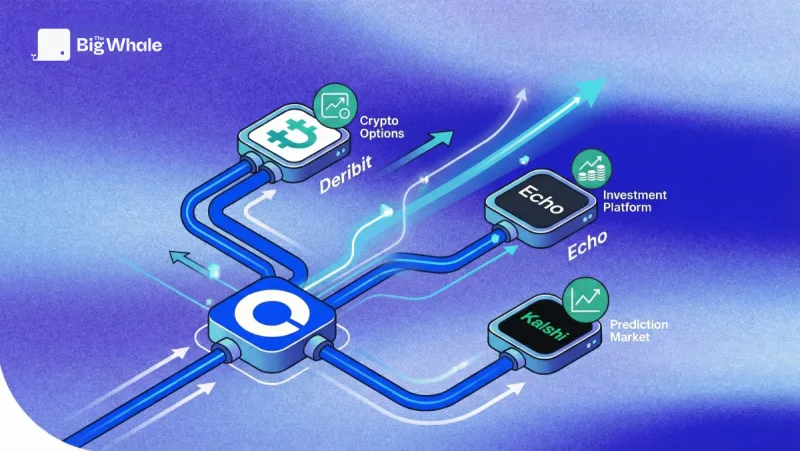
Key takeaways
- Coinbase is the main driver of crypto M&A in 2025, with nearly 19% of committed amounts in an exploding market (+532% year-over-year).
- The strategy aims to transform the business model, from a simple spot exchange to an integrated platform (derivatives, venture capital, services, prediction markets).
- Deribit is the key acquisition, offering Coinbase immediate exposure to the most profitable market segment (options), with a rapid impact on results.
- The operations appear overall value-creating, despite dilution, and strengthen the optionality of COIN stock.
Mergers and acquisitions (M&A) activity in the digital assets space has been intense this year, marked by strong fintech-crypto integration (Stripe's acquisition of Bridge) and cross-industry buyouts led by Coinbase, Kraken and Ripple. The figures speak for themselves.
The value of M&A deals in digital assets, excluding the fourth quarter, exceeded last year's total by 532%, rising from $2.8 billion to $17.7 billion over three quarters. The number of deals has followed the amounts raised, climbing from 128 deals in the first three quarters of last year to 241 in the same period this year, an increase of 88.28%.
.png)
This transaction volume mainly relates to acquisitions and mergers, excluding reverse mergers, SPACs and private financings. If venture capital (VC) placements are added to the mix, the total exceeds $33bn, a significant step towards greater capital penetration in the digital asset market.
Overview of Coinbase's M&A deals
Coinbase dominated the rankings in size, completing some of the largest deals of the year. In 2025, the company generated around $3.275 billion in trading volume, or 18.5% of the total.
Of the eight disclosed deals, thelargest was Deribit for $2.9 billion, covering two highly lucrative verticals in the digital asset market: derivatives trading and seed-stage investment.
Coinbase acquired six other companies without disclosing amounts, including Liquifi (token management platform), Vector (Solana trading platform), Stryk (Cyprus-based CFD trading unit) and Spindl (on-chain advisory platform).
In addition, the company operates its venture capital arm, Coinbase Ventures, which invests in seed and early-stage start-ups in the digital asset industry.
Unlike other venture capital firms, Coinbase Ventures funds operations from the parent company's balance sheet, using primarily excess cash and equity compensation, eliminating the need for external Limited Partners (LPs) and making the entity the sole beneficiary of investment returns.
Coinbase Ventures participated in 65 deals in 2025, mainly as lead investor ("lead"), with a total value of $1.25 billion.
The exact amounts raised by Coinbase Ventures are not known. However, as lead investor, it can be estimated that they have invested between 30% and 50% of this amount, or between $375 million and $675 million.
The largest venture capital deal completed by the company in 2025 was participation in the $300 million placing of prediction market platform Kalshi, valued at $11 billion after its latest round.
.png)
Analysis of major deals
Three major transactions totalling $3.275 billion and one participation in a $300 million private placement have marked Coinbase's M&A activity this year and have already proven to create value for the company.
However, it is essential to understand the strategic rationale, financial value and risks for each of these major transactions in order to objectively assess the company's capital allocation credentials.
Acquisition of Deribit (value: $2.9 billion)
With this deal, the objective was clear: to enter the extremely lucrative derivatives market, complete the trading offering and establish itself as a central player in the fast-growing market for options on digital assets.
Today, the derivatives segment concentrates the bulk of activity and significantly outperforms the spot market, with a ratio of 3.18 to 1. In August 2025, global trading volumes reached $9.7 trillion, of which 7.8% was in options, up 2.1 points year-on-year to $753 billion.
On its own, Deribit captures between 25% and 27% of global options volumes. Even more striking, the platform is said to concentrate between 85% and 95% of open interest in BTC and ETH options, according to several sources.
Two months after its takeover, in July 2025, Deribit generated $30 million in options revenue from $185 billion in volumes, or around 1.6 cents per dollar traded.
The momentum is just as spectacular over the long term: volumes were up 95% in 2024 compared with 2023, with a four-year compound annual growth rate of 50.66% since 2020.
This explosive growth, coupled with an ultra-dominant position in derivatives, made Deribit an obvious target for Coinbase, keen to capture a significant share of the rent generated by the cryptoasset options market.
.png)

Financial value of Deribit buyout
The deal was funded by $700 million in cash and 11 million Coinbase Class A shares. The first effects were felt as early as July: Coinbase reported $30 million in revenue from option fees, an annualised rate of $360 million. At the same time, general and administrative expenses (G&A) rose by around $10 million per quarter, resulting in an improvement of close to $27 million in operating income.
The impact was swift, although the Deribit buyout was not the only factor behind the rally in Coinbase shares between May and July.
Over the period, Coinbase's revenue, operating profit and EBITDA jumped by 26.2%, 104% and 110.5% respectively quarter-on-quarter.
Despite a dilution of 4.29% for existing shareholders, the share has risen by 34% since the announcement of the Deribit acquisition.
At unchanged growth rates (and even while a higher compound annual growth rate is still conceivable) the $2.9 billion investment could be amortised in just over six years (6.33 years). In this scenario, Deribit would generate an annualised return of around 29%, higher than Coinbase's current cost of equity, estimated at 26.59%.

Risks associated with the Deribit acquisition
At this stage, US residents still do not have access to Deribit's full derivatives offering, making regulatory approval in the US a central strategic issue for the acquisition.
The main growth driver is based on obtaining clarification and authorisations from US regulators (first and foremost the CFTC) for the distribution of options and perpetual contracts on the US market. Conversely, a refusal of approval or the introduction of unfavourable rules would severely curtail the investment thesis, by limiting access to US institutional clients, the heart of revenue potential.
In this context, competitive pressure remains high. Players such as Binance or OKX, largely dominant in the global derivatives market, are expected to intensify competition on fees and product innovation, at the risk of eroding Deribit's currently very high market share.
Acquisition of Echo (value: $375 million)
Echo has established itself as one of the leading fundraising platforms for seed-stage projects. In just two years of existence, it raised more than $200 million before being acquired by Coinbase for $375 million, via a combination of cash and Class A ordinary shares.
This acquisition completes Coinbase's "services" brick around token and protocol management, opening up new revenue streams beyond trading fees alone.
The group now intends to cover the entire value chain: creation and management of tokens, fundraising and distribution via Coinbase's Base infrastructure and CEX, while charging commissions on funding rounds and token launches.
Financial value of Echo acquisition
Token launch platforms ("launchpads") have demonstrated particularly high profitability, as illustrated by the case of Pump.fun. These players generate between $3 million and $6.5 million in fees per week, with peaks of up to $40 million during periods of euphoria.
Beyond direct revenues, the integration of Echo offers Coinbase a strategic advantage: the ability to allocate capital further upstream via its venture arm and capture investor sentiment on projects that are still in their infancy at an early stage.
Risks associated with the acquisition of Echo
The main risks relate to the potential saturation of the platform and the integration of Echo's existing user base. The latter has been built on a highly selective proposition, focused on "early-bid" fundraising.
Backing it with a player of Coinbase's size could dilute this scarcity, erase the early-stage effect and reduce investors' ability to obtain significant allocations on seed-stage projects.
Also, Echo is strongly associated with its founder, Cobie: sidelining or marginalising his role would pose a significant cultural and integration risk.
Investment in Kalshi (via Coinbase Ventures)
Prediction markets are emerging as one of the most followed stories in the crypto ecosystem since 2024.
Polymarket's indicators show a typical S-curve trajectory: between 1 September and 3 December, the number of unique active wallets rose from 14,362 to 70,125, transactions from 142,431 to 838,209, and volumes from $14.65 billion to $19.8 billion.
An impressive dynamic, but now matched by Kalshi (whose data is declarative because the project is not built on a blockchain like Polymarket), which has taken the lead across all these metrics and is establishing itself as the new benchmark player in prediction markets.
The company is now targeting an annualised volume of $50 billion.

Kalshi's financial value
Coinbase Ventures is among the key investors in Kalshi's Series D, in which the platform raised $300m in early October, based on a $5bn valuation. This investment provides access to around 6% of the capital (split between a number of venture capital funds, including Coinbase).
In the context of a massive influx of capital into prediction markets, valuations are rising very quickly. In less than two months, Kalshi has reportedly seen its valuation climb to $11 billion, effectively doubling the value of Coinbase's stake. As this is a venture-type investment, and as long as appetite for this segment remains strong, Coinbase could expect to make several multiples on its initial stake when it unlocks its shares.
Risks associated with investing in Kalshi
The risks associated with Kalshi remain relatively limited, but not negligible. The main one relates to the regulatory environment: the platform is overseen by the CFTC, which retains the ability to ban certain prediction markets deemed sensitive or controversial, with a potential impact on volumes and user confidence.
Also, this is a private investment. Coinbase has no control over Kalshi's governance or strategy and remains exposed to a possible deterioration in valuation before the end of the vesting period, when its stake is released.
Impact of the M&A strategy on Coinbase shares
The Coinbase share has had an eventful year. Up 12.26% since the start of the year, the stock posted an all-time closing high of $419.78 in the wake of the bitcoin and ether rally in the summer of 2025. As in the first half of the year, $COIN then remained closely correlated with the digital assets market, retreating by around 34% from that peak.
Despite this bumpy trajectory, the stock's optionality remains high, buoyed by the scale of the acquisitions made by Coinbase. While these transactions have yet to be fully priced in, analysts are anticipating a forecast price/earnings (P/E) ratio of 34.61, compared with a rolling twelve-month (TTM) P/E of 23.96. This difference suggests a potential upside of 44.4%, which would bring the stock back to around $401.43 from its current level.
This reading is based on the assumption of a rapid ramp-up of the new growth drivers stemming from the M&A strategy being pursued in 2025. Deribit alone could contribute up to $324m of operating income in the first year, provided that the intensity of options trading is maintained.
The Big Whale's view
Coinbase is clearly establishing itself as one of the industry's central players and is taking full advantage of its listed status, particularly by mobilising the equity market to finance large-scale transactions (as was the case with the Deribit buyout).
At this stage, the acquisitions made in 2025 appear to be coherent overall: some are already making a direct contribution to sales and earnings, as in the case of Deribit or the capital gains linked to the stake in Circle. The market is not mistaken, incorporating these prospects into significantly higher projected multiples for next year, following an all-time high for the share reached in July.
However, this strategy once again raises the question of the boundary between centralisation and decentralisation. In the short term, institutional investors favour Coinbase for the robustness and legibility of its offering. But competitive pressure between centralised platforms is intensifying, and the technological gap with decentralised alternatives is narrowing. In the medium term, it cannot be ruled out that the latter will demonstrate superior efficiency and emerge as the natural choice for the next generation of traders.