TBW - Matt Hougan (Bitwise): "Vaults are the most important innovation in asset management since the invention of ETFs"
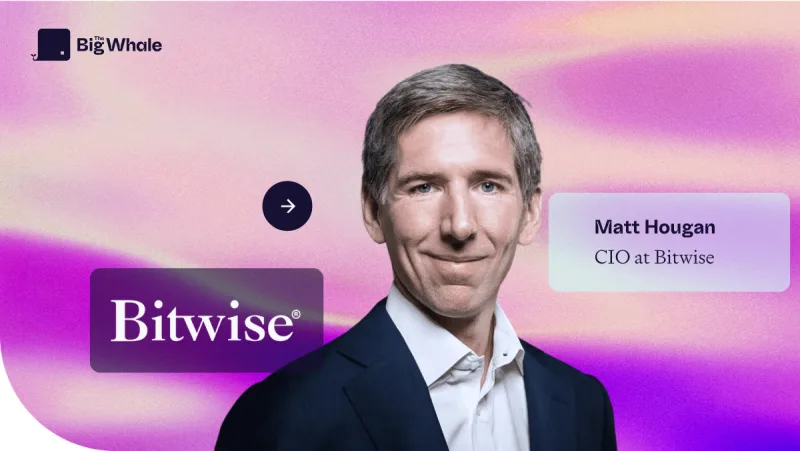
The Big Whale: Players like BlackRock and soon Amundi in Europe now dominate the crypto ETF landscape. How can a specialist player like Bitwise compete against their distribution power and operational efficiency?
Matt Hougan: It's a legitimate question, but experience tells us that BlackRock's entry has been a catalyst for Bitwise. Certainly, their product (IBIT) has captured massive volumes, but above all they have increased the overall size of the pie.
To compete, we are applying the recipe of managers specialising in other asset classes: what Blackstone is to alternative assets or KKR to private equity, Bitwise is to crypto. The reality is simple: with around 150 employees, we probably have more people dedicated exclusively to digital assets than BlackRock and Amundi combined.
This ultra-specialisation translates into surgical responsiveness. If an institutional client asks us about the tokenomics of an obscure protocol, our research team provides a full analysis in less than 24 hours. This level of expertise creates confidence that generalists, despite their size, struggle to match.
>> EXCLUSIVE. Amundi enters the crypto ETF race
Fittingly, Morgan Stanley is also entering the arena with Bitcoin, Ethereum and Solana ETFs. Doesn't this run the risk of locking up the distribution market for good?
Their arrival confirms an underlying trend. But we are entering a new phase. Phase 1" was that of single-asset products (Bitcoin alone). "Phase 2" will be indices, thematic strategies and active management.
It is easy for a Morgan Stanley adviser to sell their own Bitcoin ETF for convenience. However, on an index fund, our eight-year track record is second to none. We have proven our ability to manage risk, notably by avoiding the collapses of Luna or FTX thanks to our internal controls. It is on this expertise in designing complex products that we will win market share from the massive distributors.
While BlackRock's ETF is the behemoth, a Bitwise product that captures 10% or 15% of the market still represents $10 billion to $20 billion under management over time"
The ETF market seems to be heading towards a "power law" where the frontrunners capture everything. Is it still viable to be the third or fourth player?
At all. In ETFs, the leader often takes more than 50% of the shares, but the subsequent positions remain extremely lucrative. While BlackRock's ETF is the behemoth, a Bitwise product that captures 10% or 15% of the market still represents $10 billion to $20 billion under management over time. That's a very significant size for any issuer.
"Eventually, I'm convinced that almost all crypto ETFs will incorporate staking"
Why would an institutional choose Bitwise over BlackRock today?
For three clear reasons. First, the cost: we are 25% cheaper, with fees of 20 basis points compared with 25 at BlackRock. Secondly, the "crypto-native" ethos: we donate part of our profits to Bitcoin Core developers and we publish our on-chain addresses for total reserve transparency. Finally, support: choosing Bitwise means choosing a partner capable of responding to complex technical and regulatory issues, not just a supplier of financial building blocks.
Can we imagine even more aggressive fee compression, below 0.10%?
We're thinking about it, but 20 basis points is already an extremely low level. By way of comparison, the world's largest gold ETF is at 40 basis points. Sovereign wealth funds and university endowments such as Harvard are already using our ETFs because they are incredibly competitive. There may be a slight compression when we reach $100 billion under management, but we are already on "institutional" price levels.
Your Solana ETF (BESOL) attracted a lot of interest last quarter. More generally, are you seeing a real premium for products that include staking over traditional products?
Absolutely. Investors are asking for staking. In Europe, where our products have included this feature for longer than in the United States, the impact on inflows is undeniable. However, it is correlated to the underlying asset. On Solana, with a yield of around 7% a year, it's an argument that's impossible for a manager to ignore. On Ethereum, at around 2%, it's an appreciable 'plus', but less decisive.
In time, I'm convinced that almost all crypto ETFs will incorporate staking. The current obstacles, particularly tax and logistical in the US, are gradually disappearing.
Can we imagine a similar scenario for Bitcoin via DeFi protocols?
This is a subject we are obsessed with. If we were able to generate returns on a Bitcoin ETF in a secure way, it would be a major competitive advantage, particularly against slower players like BlackRock.
The challenge remains to find a DeFi integration or staking model that is sustainable, with an acceptable risk/return ratio for institutional investors. Our teams are actively working on this issue. It's not for tomorrow morning, but in the long term, the answer is yes.
You're also banking heavily on multi-asset products. Is this where the real future profitability lies for Bitwise?
Over a ten-year horizon, I'm convinced of it. Today, buyers of Solana or Bitcoin ETFs are well-informed investors who know the ecosystem inside out. But tomorrow, the 'average' investor will not want to do stock-picking of tokens. They will want global exposure to the sector, stablecoins or tokenisation, in the same way as they buy indices for equities or commodities. The future of crypto in asset management will resemble all other asset classes: a domination of diversified strategies.
"Morpho is a benchmark institution in DeFi"
You recently launched a vault in partnership with the Morpho protocol. How is this product structured and who is it aimed at?
We are very excited. This safe targets a 5-6% return by operating on the safest segments of the lending market: over-collateralised BTC/ETH pairs against stablecoins. It's a liquid and secure market.
For me, vaults are the most important innovation in asset management since the invention of ETFs. It is the first non-custodial management service. Eventually, trillions of dollars will flow through these structures. For the time being, we are targeting crypto-native institutions that are looking for an established manager with an eight-year risk management track record. TradFi will come next, but the structure is already ready for them.
>> Fixed-rate loans, P2P matching... Everything you need to know about the new version of Morpho
Why did you choose Morpho as your technical partner?
In our position, we only work with "Blue Chip" partners. Morpho is a benchmark institution in DeFi, with a solidity proven over time and partnerships with players like Gauntlet or Steakhouse, which we respect enormously. For Bitwise, it was a natural choice to enter this market rigorously.
>> EXCLUSIVE. Revolut chooses Morpho for its DeFi yield offering
The role of "vault curator" seems to be becoming a new job in its own right. Is this a role that you will be strengthening?
It's a business of the future, at the crossroads of traditional asset management, risk auditing and technical programming expertise. At present, the vault market is in its infancy, but it will follow the same trajectory as ETFs. Thirty years ago, the big mutual fund managers ignored ETFs; it was the natives who took the lead. The same thing will happen here. If a young professional wants to build a career today, risk management and on-chain asset selection are segments to focus on.
>> >> Risk curators: at the heart of loan market management in DeFi
Last question: are you planning to launch a euro-denominated vault?
That's an excellent suggestion. We want to be a dominant player and we know that we need to be more agile than the traditional mega-managers who are also looking at these technologies. I'll be discussing this with my team today. Europe is a key market for us, and demand for regulated and professional on-chain performance solutions is strong there.