TBW - Oil: how the USDT enabled Venezuela to circumvent US sanctions
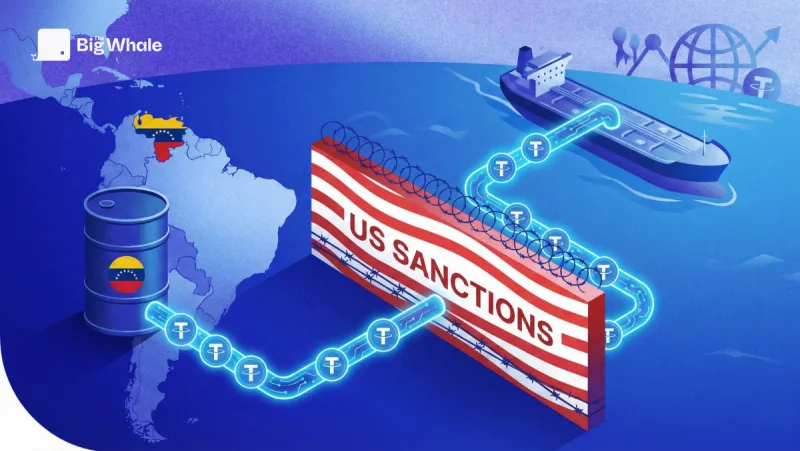
The arrest on Saturday of Nicolás Maduro by the US authorities marks a turning point in a tug-of-war that has lasted nearly ten years between Washington and Caracas. The charges brought by the US justice system (drug trafficking, corruption and money laundering) remain at the heart of the case, of course. But another element weighs heavily in the background: the way in which Venezuela has used digital assets to continue selling its oil despite US sanctions.
Since 2019, the United States has been applying full financial sanctions against PDVSA, the national oil company, as well as the Central Bank of Venezuela. The US Treasury's message is clear: to prevent Caracas from accessing the international dollar banking system.
As an analysis by the Atlantic Council, a bipartisan US think tank, published in November 2025 reminds us, oil accounts for almost 90% of the country's exports. Suffice to say, these sanctions are affecting the very heart of the Venezuelan economy.
Faced with this financial stranglehold, the regime has gradually put in place an avoidance strategy based on cryptocurrencies, and especially stablecoins indexed to the dollar. The most widely used is USDT, issued by Tether.
According to the Atlantic Council, PDVSA began, from 2024 onwards, to ask certain customers to pay for part of their shipments in USDT in order to avoid payments passing through banks that might block them.
Reuters had confirmed this shift in the spring of 2024: the agency revealed at the time that PDVSA was switching a large proportion of its spot oil sales to advance payments in USDT, in the wake of the reinstatement of US sanctions. New customers were even being forced to open a crypto wallet in order to trade with the company.
The aim was simple: to limit the risk of funds being frozen in foreign accounts as soon as the sanctions framework tightened.
It was in this climate that Tether, the issuer of USDT, took a public stance. In response to information published by Reuters, the company announced in 2024 that it was committed to freezing all addresses associated with US-sanctioned entities, stating that it "complies with the OFAC SDN list and promptly freezes any addresses linked to sanctions".
An important reminder: unlike fully decentralised cryptocurrencies, USDT can be technically blocked by its issuer.
For Venezuela, however, the use of crypto is by no means a sudden reflex. Back in 2018, the government had already attempted to launch its own digital currency, the petro, which was supposed to be backed by oil. The project fizzled out and was abandoned in 2024, but it testifies to the constant pressure exerted by international financial restrictions.
The Atlantic Council also points out that the USDT is part of a broader strategy, already seen in Iran and Russia: combining digital payments and "shadow fleet", those opaque tanker fleets that allow sanctioned crude to flow by circumventing controls.
This phenomenon has obviously not escaped Washington's notice. The Atlantic Council is now recommending closer cooperation between US authorities, crypto platforms and stablecoin issuers in order to cut off these financial circuits. The think tank also points out that Tether has already frozen several addresses as part of investigations in Latin America.
Crypto doesn't explain everything. But it has enabled the Venezuelan regime to maintain vital oil revenues despite sanctions, to the point of becoming a strategic issue in its own right in the confrontation between Washington and Caracas.