TBW - Self-custody: towards mandatory declaration of crypto wallets from €5,000 in France
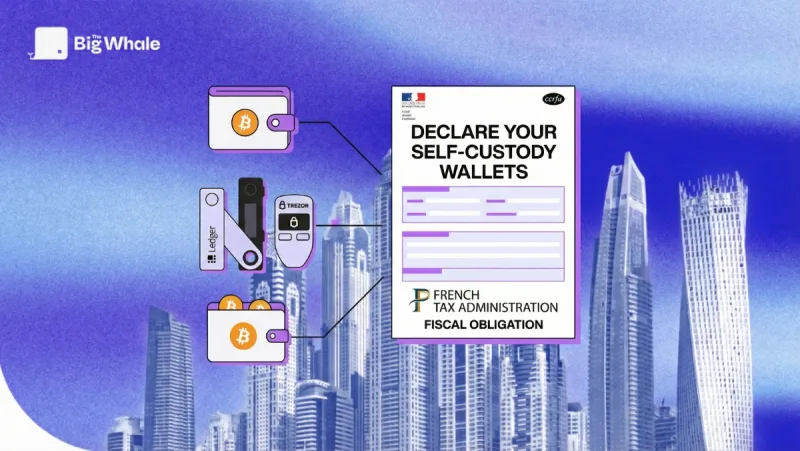
This is a potential turning point in the tax regulation of digital assets in France. Last Tuesday, an amendment tabled by the Communist Party was passed, aimed at requiring holders of cryptocurrencies to declare their "self-custody" portfolios to the tax authorities, once their value exceeds €5,000.
A second similar amendment, backed by the presidential party's rapporteur, strengthens the likelihood of this measure being definitively incorporated into the text of the law.
For investors using solutions such as Ledger, MetaMask, Rabby or Deblock, this development marks the end of a tax grey area, but opens up a complex debate on the very nature of these assets.
Alignment with CPO recommendations
This legislative initiative does not appear out of thin air. It is in line with the recommendations of the Conseil des prélèvements obligatoires (CPO), a body attached to the Cour des Comptes. In its report published last week, the CPO specifically pointed the finger at non-crypto-asset portfolios as vectors of wealth opacity.
The legislator's logic is as follows: in France, crypto-assets are considered to be financial assets. As such, any digital asset account opened abroad (on centralised platforms such as Binance or Coinbase) must already be declared via form 3916-bis, in the same way as a Swiss bank account.
The administration now wants to extend this logic of transparency to portfolios held in their own name.
The debate: digital gold or financial account?
This is where legal analysis comes up against technical reality. Self-holding of digital assets (without an intermediary) is more similar in philosophy to holding physical gold or works of art at home. However, the possession of bullion or jewellery is not subject to declaration until it is transferred.
By imposing this declaration, the French state therefore seems to be making a decision: crypto in self-custody is not a movable asset comparable to gold, but a pure financial instrument that must be traced, regardless of how it is held.
A security context under high tension
While the measure is justified from the point of view of tax fairness, it gives rise to serious concerns in view of the security context in 2025. The creation of a centralised file listing holders of physical wallets (cold wallets) is perceived as a systemic risk by part of the ecosystem.
Three recent events are fuelling this fear:
- The wave of attacks: Since January 2025, a series of violent sequestrations (home-jackings) specifically targeting holders of crypto-assets has been observed in the territory.
- Massive data leakage: Last May, a database containing the tax and personal information of two million French taxpayers was hacked and put up for sale on the dark web for $3,000.
- Internal corruption: In July 2025, trust was shaken by the arrest of a tax officer, suspected of passing confidential information to criminal networks facilitating targeted burglaries.
The ecosystem is up in arms
"These amendments introduce widespread patrimonial surveillance of crypto holders, which does not exist for other assets (gold and works of art, for example)," laments Claire Balva, CEO of Adan, the French trade association that defends the interests of the crypto sector.
"This creates obvious risks for individual freedoms and the protection of privacy, in a context where these holders are already regularly targeted", she warns.
Before insisting: "The measure is inapplicable in practice: the administration can neither verify the existence of a portfolio, nor the declared valuation. It would therefore be based on self-assessment, with no supervised methodology and no capacity for control."
The Big Whale analysis
For investors, this measure changes the game. It reduces the attractiveness of self-holding for reasons of pure confidentiality vis-à-vis the state, while paradoxically increasing the physical security risk in the event of a data leak.
If the amendment is confirmed in the public session, it will place France among the strictest jurisdictions when it comes to the traceability of on-chain portfolios, forcing market players to arbitrate not just between volatility and yield, but between tax compliance and personal security.